‘End of the Liberal honeymoon’? Holt orders big cuts to gov’t spending

By: John Chilibeck, Local Journalism Initiative Reporter.
Source: The Daily Gleaner

Premier Susan Holt has asked all departments to find savings of 10 to 15% in the lead-up to the 2026 budget in March. Photo: John Chilibeck, Brunswick News

New Brunswick Premier Susan Holt says she’s asked all government departments to find savings of 10 to 15% in time for the 2026 budget in the spring, an enormous undertaking.

This year’s provincial budget was $14.3 billion, so cutting 10% of that would be more than $1.4 billion.

Slashing 15% would top $2.1 billion.

“Given the current fiscal and economic environment, all departments have been asked to conduct a robust review of all potential efficiencies or cost savings of roughly 10 to 15 per cent as part of this year’s budget planning process,” Holt said on Friday in a prepared statement sent to Brunswick News.

“This is an exploratory exercise intended to help inform budget decisions and ensure public dollars are being used as effectively as possible. The objective is to manage pressures responsibly while continuing to prioritize investments in the services New Brunswickers rely on most.”

Holt was not made available for an interview, so it’s unclear how strict she will be in imposing the savings on different departments.

Since coming to office in October 2024, her Liberal government has been on a mission to improve health care, passing out $15,000 in bonuses to nurses and signing doctors to a four-year, $270-million deal.

It has also racked up the deficit, largely because of more spending, not a revenue shortfall.

At last count, the red ink was nearing $1 billion. It’s a far cry from the seven straight years of surpluses, largely under the previous Progressive Conservative regime of Blaine Higgs.

‘Hard choices’

Professor Tom Bateman. Photo: St. Thomas University

“This is the end of the honeymoon,” said Tom Bateman, a political scientist at St. Thomas University in Fredericton.

“A political party campaigns on lots of largesse and lots of spending and lots of problem solving, and then they get in and realize it’s actually difficult. The money’s not there and hard choices have to be made.”

He said if the exercise goes well for the Holt Liberals, they’ll retrench and be able to come out of it without drastic cuts in the third and fourth year of their mandate, making it easier to be re-elected.

But Bateman warned there didn’t seem to be any big revenue windfall on the horizon that would bail out the provincial government. Holt and other ministers have talked about developing mines, but such projects typically take many years to get going and to start generating royalties and taxes.

He was betting Holt’s move could sell well politically.

“There is a sense that Liberals can cut more effectively than Conservatives,” he mused. “I’ve always thought Liberals can do it because they always have a tear in their eye, whereas when Conservatives do it, everyone thinks they have a smile on their face.”

‘Load of hooey’

New Brunswick’s opposition parties described Holt’s statement as two-faced.

“I think it’s a comms exercise. It’s a load of hooey,” said interim Progressive Conservative leader Glen Savoie, who runs the biggest opposition party in the House.

PC Opposition Leader Glen Savoie

“They promised they were going to balance the books and by the end of this fiscal year, they will have created a billion-dollar deficit,” he said.

“And now she’s trying to make New Brunswickers believe she’s going to cut departmental spending by 10 to 15% a smoke and mirrors attempt to make New Brunswickers believe she’s fiscally responsible?”

Savoie guessed that Holt might dial back the cuts to make people think she was saving jobs and could be “tagged as some kind of hero. I don’t buy any of it.”

The PC leader said no one would argue that a government can’t find certain efficiencies, but to suddenly decide to make major cutbacks after heavy spending in the first year was irresponsible.

“They’ve got nowhere else to go but cut bodies. This is completely self-inflicted, self-created and I’d like to know how they plan on sustaining this level of spending due to all the contracts they’ve already signed and promises already made.”

‘Blindly swinging an axe’

David Coon, leader of the small opposition Green party, called the premier’s statement “spin.”

“How could you possibly cut that much money from a department like health, a $250-million cut, when you need to invest more money to drive collaborative practices until everyone is attached to a primary health-care provider?”

Green Party Leader David Coon

The Liberal government fulfilled its promise by creating 11 collaborative care practices in different parts of the province this year, one more than expected.

The Liberals said it was part of a bold move to get everyone a family doctor or nurse practitioner, through team-based practices.

Next year, they plan to add at least 10 more. But Coon pointed out that the first 11 were easier – all of them were created in existing doctors’ offices or clinics. The next 10 will be more costly because they’ll need new spaces.

“We’ve done some math on this,” the leader said of his small Green team.

“The Liberals put $30 million in the budget this year for collaborative care clinics, and next year they’ll have spend about $54 million if they really want to achieve their targets.”

Coon argued that New Brunswick had to go into deficit because the needs are extreme in health care, education and housing.

He said he’d never been a fan of across-the-board, percentage cuts.

“It’s like blindly swinging an axe,” he said.

“In the process of restructuring departments – which should happen in a number of cases – you can find savings. You might say one department is top heavy, so you reduce the number of middle managers. But it has to be done strategically,” he added.

“I mean, cutting five or 10% is what the Tories would do. In some departments you can find savings, and in others you need to spend more.”

This story from Brunswick News was written by Local Journalism Initiative Reporter John Chilibeck.

Posted in LJI stories, New Brunswick government, New Brunswick politics | Tagged , | 2 Comments

Peaker plants, batteries & Swiss Army knives: Tantramar councillors quiz NB Power on Isthmus gas plant

Tantramar Councillor Allison Butcher questioning NB Power VP Brad Coady

NB Power Vice President Brad Coady says the proposed 500 MW gas/diesel plant on the Chignecto Isthmus would serve many functions.

“I describe it as the Swiss Army knife that our system doesn’t have today,” Coady said in response to a question from Councillor Allison Butcher, who asked whether the project could be described as a “peaker plant” designed to switch on and off rapidly to meet surges in demand.

“Yes, I think some people could use the label of peaker plant,” Coady replied, adding, however, that the facility’s main function would be to stabilize the grid. He explained that its generators would operate about 85 per cent of the time without burning fuel, spinning in sync with the grid to provide stability as more wind and solar power are added to the system.

“The peaker plants I’ve been reading about, there’s a lot of issues with them,” Butcher said, referring to public health and environmental concerns highlighted in American studies that conclude such plants are harmful to local communities because of the high levels of pollution they emit.

Old school & new

Butcher went on to ask why John MacIsaac, Canadian president of PROENERGY, the company that plans to build the gas plant, has described it as technology that would bring “old school stability” to the power grid.

Coady replied that the gas plant would help NB Power integrate more renewable sources in its transition to “net zero” carbon emissions by 2035.

“We’re trying to figure out how do we get out of the old school and into the new school,” he said, “but we keep running into technical challenges that we haven’t figured out quite yet.”

Councillor Josh Goguen

Coady used the Swiss Army knife comparison again in responding to a question from Councillor Josh Goguen who asked why NB Power is rejecting grid-scale energy storage batteries for use during periods of peak demand.

“Have you guys looked into something like this instead of putting a 400 megawatt power plant in?” Goguen asked.

“We do face these questions every day.” Coady said. “Why not a battery?”

He added that he takes to heart Green MLA Megan Mitton’s comment that in rejecting batteries, NB Power is thinking like a dinosaur.

Coady went on to suggest that wind turbines in New Brunswick produce only 40% or less of their full or nameplate capacity for nine months of every year so there isn’t a reliable enough supply of wind energy for batteries to store and besides, batteries may supply power for four hours, but what happens if you need it for six or 10 hours or even three days?

“The Swiss Army knife that I referred to,” he said, “allows us to cover off all those things.”

In the meantime, he said, NB Power began putting out requests for grid-scale batteries in 2023 and is continuing to do so, but must justify the costs to the Energy & Utilities Board.

‘Game changer’

Coady used his Swiss Army knife reference a third time after Councillor Goguen asked why NB Power wants to put all 10 generating units in one spot instead of distributing them around the province.

NB Power VP Brad Coady

“If we were to do a small amount of generation all around the province, that is a technically viable solution,” Coady said, adding that NB Power had considered it, but knew there would be disadvantages.

“We don’t have the same benefits of natural gas being available throughout the province,” he said. “We’d have to run it on light oil or diesel fuel, which has got more emissions than natural gas.”

Coady also argued that putting the generators together would cost less than building 10 separate plants.

He pointed to another advantage that the gas plant would have. He said the relatively small 50 MW generators could be fired up individually as needed unlike larger, 350 MW generating units that must be turned on all at once.

“If we only need 50 MW, we can get only 50 MW from this facility without having to start the other seven or eight units,” he said.

“That’s an incredible game changer for our system today,” he added. “That’s the Swiss Army knife that I’m talking about.”

Water issues

Councillor Bruce Phinney asked about the water that farmers in the Centre Village area need for their animals. The plant is projected to extract up to seven million litres of groundwater per day.

“What are you willing to do for all the farmers affected, if, when they run out of water or water is contaminated?” he asked.

NB Power senior environmental technician Matt Gorman

Coady replied that PROENERGY is conducting well drilling and water testing to determine how much groundwater there is in the area and will have to show provincial regulators that there will be no adverse impact.

“I will say, there’s likely going to be an impact,” he said. “You can’t drill a well and expect to say there’s not going to be an impact.”

Later, NB Power’s senior environmental technician Matt Gorman suggested that if tests determine there is not enough water, regulators might consider requiring alternatives such as “on-site water storage and a tower” to offset demands on the aquifer.

Coady assured council that the results of the water testing will be made public likely by the end of January and certainly by the end of March.

‘Smoke screen’

Members of the public weren’t allowed to ask questions during the council meeting and will have to wait for another public meeting on January 14th.

In the meantime, Barry Rothfuss of the Coalition to Protect the Chignecto Isthmus reacted to what he heard by accusing NB Power of putting up a smoke screen to hide the noxious effects a gas peaker plant would impose on residents and the environment.

“There are literally over a thousand of these types of plants in the U.S. alone,” he said.

“Peaker plants have a huge history of pollution in underprivileged or underdeveloped communities that can’t fight back,” he added.

“Now add on all of the other environmental concerns and issues that we know about, the issue of biodiversity loss, the issue of it being a major driver behind climate change, all of that was just obfuscated because of them wanting to force this project forward,” Rothfuss said.

“We are going to damage the wetlands that are critical from an environmental standpoint affecting two provinces here just for the sake of economics and to build a plant like this in the location where they can do it as quickly and dirtily as possible.”

Tantramar MLA Megan Mitton

Tantramar MLA Megan Mitton objected to Coady’s contention that grid-scale batteries would be too expensive as she pointed out that battery prices have dropped dramatically in the last few years.

“I think they’re using really outdated information, as well as an outdated way of thinking about the grid,” she said.

“They need to move to distributed energy, which basically means decentralized, means not having huge power plants,” she added.

“Instead, it’s having wind and solar all over the province along with batteries and investing in and going a lot faster on energy efficiency. At the rate they’re going with their energy efficiency, like the heat-pump program, for example, they wouldn’t get to all the eligible households ’till the 2050s at this rate,” Mitton said.

“There are a lot of alternatives to this fossil-fuel-burning gas plant.”

For reports on campaigns against U.S. peaker plants, click here and here.

For information on battery and renewable alternatives, click here and here.

Posted in NB Power, Town of Tantramar | Tagged , | 3 Comments

NB Power says Isthmus gas plant needed to avoid risk of blackouts

NB Power officials waiting to address town council. L-R: VP Brad Coady, Project Mgr. Stephen Cooper, senior technical specialist Matt Gorman & commercial analyst Jordan Russell

This is the first in a two-part series on NB  Power’s meeting with Tantramar Town Council.

NB Power Vice President Brad Coady warned Tantramar council Wednesday night that the 500 MW gas/diesel plant near Centre Village is essential if the province is to avoid likely blackouts in the years ahead.

“I don’t say that to alarm anybody,” Coady said after he predicted what would happen if the utility’s contract to buy 10 gas turbines from the U.S. fell through.

He said NB Power would then be forced to order new combustion turbines that would probably not be available for another seven years.

“It likely means energy shortages starting in ’28, ’29, ’30, ’31 until we actually see commissioning in 2032,” he warned, adding that gas turbines such as the ones on order from PROENERGY are in high demand.

“We hear from associations like Electricity Canada and other member utilities…’How did you guys get ahead of the curve?’ because everybody else is trying to catch up to where New Brunswick is now,” Coady said.

“If we were to cancel this whole thing and say, ‘You know what, time out, let’s re-evaluate, we want to start over,’ it’s likely 2032 before we can actually see the new solution materialize.”

Coady’s warning came near the end of a two-hour, question-and-answer session with council after Mayor Andrew Black reminded the NB Power executive that the town is now officially opposed to the proposed gas plant.

‘No ideal site’

NB Power VP Brad Coady answering council’s questions as about 60 people listen

“There is no ideal site for a project like this,” Coady told council.

“It’s regrettable that it causes angst,” he said. “It can be emotionally and politically charged and we scoured New Brunswick for the right site.”

Coady added that unfortunately for some of the people in the council chamber listening to him, the Maritimes & Northeast Pipeline and three 138KV electrical transmission lines intersect near Centre Village on NB Power-owned land. He said that if the project gets approved, that intersection would eliminate the need to upset multiple landowners by extending the gas pipeline or the transmission lines across private properties.

“Having both co-located on the same parcel of land, it gives us a more beneficial, less environmental-impact solution, less-costly solution and easier-to-integrate-to-our-grid solution,” he said.

Coady said the Scoudouc industrial park had been NB Power’s primary site, but fish habitat there would have delayed getting permits from environmental regulators until after the 2028 deadline for completing construction.

He added there was also “a lot of opposition from First Nations [who] said, ‘Hey, we would prefer if you don’t build it in that location, go somewhere else.'”

Coady said NB Power had acquired the land near Centre Village as a backup and after what he referred to as “a very tense few months of investigations,” it became the primary site.

He said he understood “all the pleasant things” that people say about Tantramar, “and I said, ‘You’ve got to be kidding me, there needs to be a better place in New Brunswick than Tantramar for this type of a project’ because we understood the opposition that would come with it.”

In the end however, he said it came down to pushing ahead with a timeline and a site that would eliminate the risk of New Brunswickers running short of power in the next couple of years.

Scare tactics’

Protest signs in the town hall lobby. Mayor Black had asked community members to remove them from the chamber

After the council meeting, Barry Rothfuss, one of the founders of the Coalition to Protect the Chignecto Isthmus, accused NB Power of using “scare tactics” to justify building a gas plant on the ecologically vulnerable Chignecto Isthmus.

“They’re using the excuse that it’s this timeline that essentially is forcing them to build something that they shouldn’t be building here,” he said.

“And that they don’t have time to do other things because of the fact that our energy grid is going to start collapsing,” Rothfuss added.

“What they’re really saying is ‘forget about the environment, forget about the community, we’re going to force this on you.'”

This is the first in a two-part series. Part Two will focus on issues that members of council asked about including environmental effects, battery alternatives and the lack of council and community consultation.

Note: Tantramar’s Climate Change Advisory Committee has arranged a public Q&A session with NB Power from 7-9 p.m. on Wednesday, January 14, with the location to be determined.

Posted in Environment, NB Power, Town of Tantramar | Tagged , | 6 Comments

Premier backs Isthmus gas plant

Susan Holt speaking in the NB legislature last month

New Brunswick Premier Susan Holt appears to have thrown her full support behind NB Power’s proposed gas/diesel generating plant near Centre Village.

Speaking to reporters on Friday, Holt said the province had tried, but failed to find an alternate location for the plant, adding that New Brunswick risks running out of electricity unless the 500 MW facility gets built and that alternative solutions such as grid-scale batteries would be too costly.

She made similar arguments today during a Q & A session on CBC Radio.

“Access to stable electricity is a key condition for economic development,” she said.

“So growing our economy and having the energy we need to grow the economy is one challenge that we’re tackling, at the same time as making sure we have enough energy for New Brunswickers’ demand,” she added.

“We don’t yet have the kind of utility-scale battery solutions that we can deploy at a cost that New Brunswickers can afford,” she said.

Coalition response

Pam Novak at the Atlantic Wildlife Centre

In a news release that responded to Holt’s earlier comments rejecting alternatives Barry Rothfuss and Pam Novak of the Coalition to Protect the Chignecto Isthmus write:

“Wind, solar, and battery systems are available now. Batteries, in particular, could be installed quickly in industrial areas such as the Scoudouc Industrial Park without disturbing wetlands or wildlife habitats — and without needing a gas pipeline at all. That fact alone proves that the push for the Tantramar site is completely unnecessary.”

Rothfuss and Novak, co-founders of the Atlantic Wildlife Centre in Cookville, also write that wind, solar and battery storage are four times more energy-efficient than fossil fuel plants.

“Battery energy storage systems can be deployed faster than gas plants, respond instantaneously to peak demand, and do not require proximity to pipelines — the real reason Tantramar has been selected,” they write.

Minister’s response

Meantime, provincial Environment Minister Gilles LePage has responded to a letter from Rothfuss and Novak without answering their argument that community members were not given any opportunity to comment on the selection of the Centre Village site. They argue that site selection is “a critical, foundational component of any environmental impact assessment process.”

Instead of commenting on site selection, LePage stresses the merits of what he refers to as an Environmental Impact Assessment Determination review.

“Determination reviews are an interactive and iterative process through which the environmental impacts potentially resulting from a proposed project are identified and mitigation efforts are proposed to avoid or minimize significant impacts early in the planning stages of a project,” he writes.

To read LePage’s letter and a similar one from Lori Clark, president and CEO of NB Power click here and here.

To read a recent New York Times article headlined “Once a Gamble in the Desert, Electric Grid Batteries are Everywhere,” click here.

Posted in NB Power, New Brunswick government, Town of Tantramar | Tagged | 7 Comments

UPDATE: Wheel comes full circle as Debbie Wiggins-Colwell wins deputy mayor’s chair

Newly elected Deputy Mayor Debbie Wiggins-Colwell presides over the council adjournment vote last Tuesday

NOTE: This post has been updated to include new information on the handling of the Code of Conduct complaint against Mayor Andrew Black.

In a move that caught some observers by surprise, Tantramar council has elected Debbie Wiggins-Colwell as the town’s deputy mayor.

At last Tuesday’s regular council meeting, she defeated Councillor Josh Goguen, the only other nominated candidate, by a vote of 5-2 gaining the support of Bruce Phinney, Greg Martin, Matt Estabrooks and Barry Hicks along with her own vote.

Councillors Michael Tower and Josh Goguen voted for Goguen while Mayor Andrew Black and Councillor Allison Butcher were absent.

Wiggins-Colwell will serve as deputy mayor until the next municipal election on May 11, 2026. The post comes with an annual pay raise of $5,258. The deputy mayor receives an annual salary of $31,548 while councillors get $26,290. Tantramar’s mayor is paid $52,581 per year.

“It’s a great feeling,” Wiggins-Colwell told Warktimes after her win. “I’m glad I had the confidence of my council.”

She acknowledged that the honour has been a long time in coming.

“Yes it has,” she said, “but it’s been a learning curve right straight through, so it’s been good.”

Black blocks vote

Before the forced amalgamation of the town of Sackville with the village of Dorchester and surrounding local service districts or LSDs, Wiggins-Colwell served as mayor of the former village and was considered a front-running candidate for the Tantramar deputy mayor’s post.

Black blocks vote on deputy mayor in January 2023

But in a controversial move that led to a code of conduct complaint against him, Mayor Black refused to give unanimous consent to add a vote for deputy mayor to the council’s first regular meeting agenda in January 2023.

The provincially imposed procedural bylaw requires a vote for deputy mayor at council’s first meeting and it has never been clear why it was not on the agenda.

Black himself explained his decision to block the vote this way:

“We have not had an opportunity to interact with one another. I would like us to be able to know each other and have an understanding of who we are as councillors and as council, before we make the decision of who would be the deputy mayor,” he said at the time.

The election for deputy mayor did not happen until February 2023 when Greg Martin narrowly defeated Wiggins-Colwell by 5 votes to 4.

Martin, who represents the former Point de Bute LSD, was supported then by Mayor Black and councillors Michael Tower, Allison Butcher, Josh Goguen and himself while councillors Matt Estabrooks, Bruce Phinney, Barrie Hicks and Wiggins-Colwell voted for her.

Code of Conduct complaint

Les Hicks

On August 7, 2023, Sackville resident Les Hicks filed a Code of Conduct complaint against Black for failing to follow proper procedures. He received a brief letter eight weeks later from then Deputy Mayor Martin saying council had met to review and discuss the complaint, adding: “Council has determined no violation of the Code of Conduct had been breached.”

An accompanying letter from Black acknowledged “error” adding that nine months later, members of council and town administrators “now have a better understanding” of the council procedures bylaw “and will work together to ensure process is followed.”

Hicks himself was not satisfied telling Warktimes he was disappointed and troubled that there was no explanation about why council had determined there had been no breach of the code of conduct.

In his response to council, he wrote:

“This might seem like a trivial matter and it might appear that I am personally persecuting Mayor Black but I assure you this is not the case. I voted for Mayor Black because of the commitment he made to transparent and accountable governance and I expect him to adhere to this promise.”

Warktimes seeks information

On November 24, 2025, the chair of the new local governance commission warned all municipal councils in New Brunswick that provincial law requires code of conduct complaints to be discussed and voted on in public.

Warktimes e-mailed CAO Jennifer Borne and Acting Town Clerk Becky Goodwin to ask for information on what happened when Tantramar council met behind closed doors to discuss the complaint against Black and how it decided that he had not violated the code of conduct.

Goodwin responded with documents from two closed-door meetings, the first on August 15, 2023:


The second, closed-door meeting was held on September 26, 2023:

The documents indicate that although a majority felt there was merit to the complaint on August 15th, by the second meeting on September 26th, the majority had decided no action should be taken.

Provincial law requires code of conduct complaints to be discussed in public, but since that wasn’t done, there is no way of knowing why the councillors who felt the complaint had merit, decided later that no action should be taken.

Mayor Black was not only present at both meetings when the complaint against him was discussed, he was also allowed to vote on whether it had merit and how it should be handled.

Posted in Town of Tantramar | Tagged , | 2 Comments

Judges side with Irvings, other timber firms on Aboriginal title claim

But Indigenous chiefs vow to fight on, saying they will seek an appeal to the Supreme Court of Canada

By: John Chilibeck, Local Journalism Initiative Reporter. Source: The Daily Gleaner December 12, 2025

The Wolastoqey Nation has hit a setback in its title claim for a huge chunk of New Brunswick’s territory, losing at the New Brunswick Court of Appeal. Photo:John Chilibeck/Brunswick News

First Nations have suffered a major setback in their title claim for more than half of New Brunswick’s territory.

The province’s highest court issued a written decision Thursday agreeing with many of the arguments presented by timber firms with huge holdings in the western half of New Brunswick that were concerned they’d lose control of their land.

The companies had appealed a lower-court decision removing them from the title claim process, but kept their lands in it, a precedent they said was completely unfair and an affront to the law.

The six Wolastoqey communities along the St. John River and its tributaries still consider those vast forests their own, and wanted a say on how they were used or get all or some of them back.

They say they never surrendered their territory and believe the Peace and Friendship treaties, the first signed between Indigenous chiefs and the British Crown three centuries ago, prove it.

“It is plain and obvious that this claim has no chance of success at trial,” said Justice Ernest Drapeau, writing on behalf of the three-judge panel on the New Brunswick Court of Appeal.

They ruled private lands are no longer subject to a possible declaration of Aboriginal title.

Legal twists & turns

People who worried about private property rights celebrated the decision, the latest in a series of legal twists and turns since Indigenous chiefs launched the title claim five years ago.

Expressing disappointment, one of the Wolastoqey chiefs told Brunswick News her side would try to appeal the case to the Supreme Court of Canada.

New Brunswick’s justice minister said he hoped it was a turning point and encouraged the Indigenous chiefs to sit down and negotiate with the Liberal government over the title claim, which could include financial compensation for their lost land.

“My client runs a small sawmill, and this was a huge burden,” said Nova Scotia lawyer Alex Cameron, who argued the case on behalf of H.J. Crabbe and Sons, the smallest of the three firms that appealed. “Particularly in the context of the trade war and the imposition of tariffs from the United States. So, this was an added burden, and he’s really glad to be out of it.”

J.D. Irving, Limited and Acadian Timber, the other two companies, declined comment.

Crown lands

Nicole O’Bryrne. Photo: University of New Brunswick Law School

The decision does not stop the title claim dead in its tracks. The judge said the Wolastoqey Nation could still pursue “a declaration” of Aboriginal title on Crown lands, owned by the provincial or federal governments, but only “a finding” of Aboriginal title on privately owned lands.

In effect, this means the Wolastoqey Nation can only seek the return of or compensation for about 30,000 parcels of Crown, or publicly owned land, a case it would still have to win in court, according to Nicole O’Byrne, a law professor at the University of New Brunswick.

When it comes to the more than 250,000 parcels of privately owned land in the territory, the nation could argue the land was stolen and given away inappropriately and seek financial compensation from the province and Ottawa.

It would not be able to win a veto over decisions made on privately held land – such as a mine being dug – or seek a share of profits from private firms that make money from the land, such as tree harvesting.

“Justice Drapeau has clarified the issue going forward with this particular litigation, regarding declarations of Aboriginal title on Crown land and land held by private interests,” O’Byrne said.

“That’s a good thing because it provides some certainty. It will be a disappointment for the First Nations, who argued for a much more expansive interpretation of what Aboriginal title meant and that private interests could be held responsible to whatever degree for the fact that the land had moved from government to private interests over the decades.”

Private lands

In the decision, Drapeau, a former chief judge of New Brunswick, said reconciliation between Indigenous people and the Crown, represented by the provincial and federal governments, wouldn’t happen by taking away people’s private property.

In law, people who own private property are called “fee simple” owners.

“In my view, remedial justice favours compensation from the Crown over dispossession of private fee simple owners in all cases,” Justice Drapeau wrote, adding it was especially the case when the land had passed through numerous “innocent hands” through the years.

But that’s little consolation for the Wolastoqey Nation because most of their traditional territory is now in private hands, not publicly owned.

The Wolastoqey Nation’s title claim includes about 60 per cent of New Brunswick. Brunswick News Archive

It’s different in much of Western Canada, particularly British Columbia, where three First Nations have separately launched successfully Aboriginal title claims in different regions. Out west, there is far more Crown land than privately held property.

The nation’s lawyers pursued a legal strategy that went after the land of what they called “industrial defendants,” seven large landowners, including NB Power and several timber firms. They labelled other private property owners, such as homeowners and smaller businesses, “strangers to the claim,” whom they insisted wouldn’t be affected by the title claim.

The former Progressive Conservative government of Blaine Higgs took issue with that idea and said all New Brunswick private property owners were under threat. Spearheaded by former attorney general Ted Flemming, it mounted a spirited defence against the lawsuit, a tactic that was abandoned last year by the incoming Holt Liberal government, which stated they’d prefer to settle the matter outside of court.

Such title cases can take up to 20 years or more and cost millions of dollars in legal fees.

“It’s a lengthy and complex decision, and we will take our time to review it,” said Rob McKee, the attorney general and justice minister, in an interview Thursday.

“But our position remains the same. Our hope is to get to the negotiating table, because that’s where the courts say is the best place to be, for reconciliation and rebuilding our relationships with First Nations. So, I hope this is a turning point in this process and we can get to the negotiating table.”

Supreme Court appeal

Chief Patricia Bernard. Photo: Madawaska Maliseet First Nation

Patricia Bernard, the chief of Madawaska First Nation beside Edmundston, said she wasn’t surprised by the ruling.

“We’re disappointed,” she told Brunswick News. “We still need to comb through it and talk to our lawyers before we decide what to do.”

However, she said the decision by Drapeau and fellow justices Kathleen Quigg and Brad Green didn’t match a recent decision at the British Columbia Supreme Court.

The Cowichan First Nation was successful in having Aboriginal title declared for a portion of the lower Fraser River and a part of the City of Richmond, directly affecting about 150 property owners.

“This decision so totally contradicts the Cowichan decision,” said Bernard, who is also a lawyer. “We now have two provincial court decisions that are so at odds with each other.”

She said the chiefs still had to talk about the ruling, but it was her bet they’d seek leave to appeal to the Supreme Court of Canada. They have 60 days to make that decision.

“We’re going to want to set good precedence, and I’d say a national precedence.”

Within minutes of that interview, the Wolastoqey Nation posted a message on its webpage.

“The Wolastoqey Nation is deeply disappointed by this decision, including its mischaracterization of our claim and its interpretation of the decision being appealed from,” it stated. “We have instructed our lawyers to seek leave to appeal to the Supreme Court of Canada.”

For information about Mi’gmaq land title claims in eastern New Brunswick, click here.

This story from Brunswick News was written by Local Journalism Initiative Reporter John Chilibeck.

Posted in Indigenous affairs, LJI stories, Nova Scotia Government | Tagged , | 3 Comments

Tantramar Council comes out against gas plant on the Isthmus

Councillor Michael Tower

At its meeting on Tuesday, Tantramar Council reversed its position on the proposed 500 MW gas/diesel plant within town limits near Centre Village when it approved a three-part motion from Councillor Michael Tower directing that:

  1. council send a letter to Premier Holt stating it is against the gas plant;
  2. the letter ask for the gas plant project to be suspended until NB Power answers questions from citizens at a public meeting that would also be attended by council’s climate change advisory committee;
  3. and that the letter ask the premier and the provincial minister of the environment to meet with council to discuss its concerns.

The vote was 5-2 with Councillors Tower, Bruce Phinney, Greg Martin, Josh Goguen and Debbie Wiggins-Colwell in favour of the motion while Deputy Mayor Matt Estabrooks and Councillor Barry Hicks were against it.

Mayor Andrew Black and Councillor Allison Butcher were absent.

In September, Council narrowly defeated a previous motion from Tower that called for the cancellation of the gas plant project with the majority arguing that council did not have the authority to make such a demand.

At Tuesday’s meeting, Tower suggested that opponents of the gas plant were concerned about protecting the area’s quality of life “without the threat to our environment, without a threat to our water or our health.”

In opposing Tower’s motion, Deputy Mayor Estabrooks said that representatives from NB Power would be meeting with council on December 17th.

“I myself would like to hear from them and be able to ask them some questions specifically before I vote in favour of this motion,” he said.

Seniors for Climate – Tantramar

Penny Mott making a presentation to council on behalf of Seniors for Climate – Tantramar

Earlier in the council meeting, Penny Mott, speaking on behalf of the group Seniors for Climate – Tantramar, urged council to take a public stand against the gas plant as an audience of about 50 listened.

Mott argued that while the project may make economic sense for NB Power, there would be enormous costs for the people of New Brunswick with the burning of fossil fuels contributing to climate change.

“This project is harmful to humans, wildlife, and the environment in countless ways,” she said, adding that the power utility as well as the federal and provincial governments are not concerned enough about its consequences.

She also pointed to the lack of Indigenous consent.

“To date, there is no approval for this proposal to be built on unceded land,” she said.

“Proceeding without free, prior, and informed consent from First Nations risks violating their inherent and treaty rights affirmed in the United Nations Declaration on the Rights of Indigenous Peoples, which is Canadian law, she added.

“Councillors of Tantramar we do need you to take a public position on this gas plant proposal before it’s too late,” she concluded.

To read a transcript of Mott’s presentation, click here.

Health effects

Retired doctor Harold Popma made a 2-minute presentation to council on the health effects of the gas plant

Council also heard a two-minute presentation from retired doctor Harold Popma speaking on behalf of the Canadian Association of Physicians for the Environment.

He warned about the health effects of the proposed gas plant.

“The burning of fossil gas and diesel in the proposed refurbished jet engines will spill out pollutant chemicals into the air and ultimately also contaminate water and soil,” he said.

“These volatile organic compounds are harmful to our bodies and they can make us sick when we breathe them and when we drink them and over 25 years the effects accumulate,” he added as he urged town council to “stop this proposal.”

To read a transcript of Popma’s remarks, click here.

‘Incredibly positive’

After the council meeting, Meredith Fisher, a member of Seniors for Climate – Tantramar, welcomed the majority vote to oppose the proposed gas plant calling it “incredibly positive.”

“I believe that if I were the premier or the prime minister, having the local government opposed to it carries lots of weight,” she said.

“If we didn’t say that we don’t want it here, they would be very happy to go merrily along and do this crazy project,” she added.

Logan Atkinson, a fellow member of the Seniors group agreed.

“We think it’s the first step towards having our council stand shoulder-to-shoulder with the resistance,” he said.

Posted in climate change, Environment, NB Power, Town of Tantramar | Tagged , | Leave a comment

AWI co-founders urge province to cancel Centre Village gas plant: ‘None of our community concerns are being heard’

Pam Novak & Barry Rothfuss co-founders of the Atlantic Wildlife Institute

The co-founders of the Atlantic Wildlife Institute are calling on the New Brunswick government to cancel NB Power’s plans to build a 500 MW gas and diesel generating plant on the ecologically sensitive Chignecto Isthmus.

Barry Rothfuss and Pam Novak say the environmental costs of the project are “just too outlandish,” a phrase they use in a letter e-mailed to Environment and Climate Change Minister Gilles LePage earlier this month after they had met with in Fredericton on November 20th.

“Public engagement in the Centre Village site selection process simply did not happen,” their letter states referring to NB Power’s announcement on July 14th that the decision had already been made to locate the plant on land it had quietly acquired nearly a year earlier.

“In fact, none of our community concerns are being heard and addressed at the appropriate time before actions are already being taken,” their letter says, adding that the community is being “railroaded” partly through an environmental impact assessment process (EIA) that did not allow for any public participation in selecting a site and partly by pushing the project through as quickly as possible.

“The goal of an EIA is to inform decision-making, and evaluate site alternatives early in the planning  process, allowing potential negative impacts to be avoided or minimized before significant time and money are spent on a specific location,” Rothfuss and Novak write.

False information

They suggest that if NB Power and its American partner PROENERGY had followed proper procedures, they would have consulted with regulatory authorities, the general public and Indigenous First Nations in the earliest stages of planning the project and evaluating a potential site.

Instead NB Power issued a news release in mid-summer suggesting this energy project would be environmentally friendly and supported by Indigenous investment, false information reinforced by PROENERGY filings to regulatory authorities, company statements at public meetings and at Tantramar Town Council.

“Greenhouse gas emissions, the draining of an aquifer, diesel gas backup, destruction of an ecologically sensitive ecosystem and wildlife corridor, light and noise pollution are anything but environmentally friendly,” their letters says.

“Marketing it as an Indigenous led project, [was] a key element in avoiding public scrutiny and trying to fast-track this project once it was announced.”

Rothfuss and Novak write that “this is a core breach of trust” designed to mislead government officials such as Premier Holt and MP Dominic LeBlanc as well as the local population and Indigenous peoples raising suspicions about all other claims made by NB Power and PROENERGY.

“Even with nothing further, it is sufficient to justify cancellation of the project.”

PROENERGY has already built a 1.5 kilometre access road to the site

3-legged stool

“There is no question this was done intentionally,” Rothfuss said in an interview with Warktimes.

“This was built on a three-legged stool approach. The first was to blindside us,” he added by depriving people of the ability to contribute their thoughts during the site selection process on how they would be affected.

“The second thing they did was lie to us. They had to promote this as something that was green and Indigenous-led,” he said.

“The third element is railroading us. They’re pushing this as hard as they can push it on an unrealistic timeline so we don’t have the time to really even research the information fast enough.”

Rothfuss and Novak’s letter says in calling for cancellation of the project, they speak on behalf of the Protect the Chignecto Isthmus Coalition they have formed with 17 other organizations as well as many others that support it behind the scenes.

They write that all are concerned about the triple crisis of biodiversity loss, climate change and pollution outlined in Canada’s official 2030 Nature Strategy on halting and reversing the loss of diverse species in the natural world.

They also point to the 2007 report from the United Nations Intergovernmental Panel on Climate Change that identified the two most vulnerable locations in North America: New Orleans and the Chignecto Isthmus.

In an e-mail to Warktimes last week, a communications officer for the provincial environment department said Minister LePage would respond to the Rothfuss, Novak letter once the information in it had been “appropriately reviewed.”

To read the AWI letter, click here

Posted in climate change, Environment, NB Power, Town of Tantramar | Tagged , | 5 Comments

From ‘boom flail mower’ to Civic Centre mural: Tantramar considers $1.8 million in capital spending next year

Tantramar Treasurer Michael Beal

At their regular council meeting on Tuesday, December 9th, members of Tantramar Town Council will be asked to approve a $1.845 million capital budget with no transfer of money into reserve funds to finance future projects.

“It is actually a reduction if you compare that to last year,” Treasurer Michael Beal said on Wednesday during a special council meeting.

He added the reduction in the total capital budget was necessary because of the provincially imposed freeze on property tax assessments.

Beal said last year’s general capital budget included $1.755 million in spending with an additional $250,000 transfer to reserves for a total of $2.005 million.

“The total capital request from [town] managers in 2026 was $4,478,000,” he added before presenting a series of slides showing which projects town managers were proposing to finance next year and which ones they thought could be deferred.

Public works

Michelle Sherwood, superintendent of public works

Michelle Sherwood, superintendent of public works, commented on a slide showing her department’s plans to spend $1.093 million next year on a variety of projects including $100,000 for resurfacing Woodlawn Road, $60,000 for resurfacing Samantha Court, $50,000 for a sidewalk replacement on King Street and $275,000 to replace the sidewalk plow that broke down last winter in Sackville.

She said public works is also asking for a $75,000 “boom flail mower” with a 13-foot reach that could clear vegetation from road shoulders.

“It will attach to the sidewalk plow and we’re currently paying contractors to mow our shoulders once in the summertime,” she said, adding that the mower could clear the worst spots on a weekly basis if needed.

Sherwood also outlined plans to spend $29,000 to improve the entrance to the Sackville Library that would include making it more accessible.

“Right now if you have a wheel chair and you’re having a hard time, you go in one door and then you have to shift over to go through the second door,” she explained.

Later Sherwood presented another slide showing public works projects that managers are proposing to defer:

Recreation spending

Matt Pryde, director of active living and culture outlined $417,000 in proposed capital spending including:

  • $125,000 to replace a condensor that is critical to the proper functioning of the ice plant at the Civic Centre rink;
  • $105,000 to replace the flooring upstairs in the Civic Centre mezzanine and lounge area as well as installing proper, skate-friendly flooring at the players’ entrance area;
  • $25,000 to improve trails including the TransCanada rails trail if council approves a plan to take control of the 18 kilometres within town boundaries;
  • $65,000 to replace the deteriorating Lilas Fawcett Park boat launch;
  • $15,000 to remove overgrown shrubs and non-native plants to make Sackville’s Memorial Park more visible from the road;
  • $17,000 to modernize the splash pad at Bill Johnstone park that was installed in 2014.

Matt Pryde, director, active living and culture

Pryde is also proposing to spend $10,000 on a mural to improve the look and feel of the Civic Centre rink.

“It would be a large art piece that would cover a big chunk of the wall and the dressing room too,” he said, “so where the banners currently are and the banners would be hung over the ice surface which was our plan all along.”

When Councillor Bruce Phinney asked who would be doing the mural, Pryde said he hasn’t decided yet.

“We talked about potentially sending it out as bit of a contest for kids to develop a concept for the mural and then hire an artist to do the actual implementation,” he said.

“We’ve also talked about involving fine arts students at Mount Allison, but we haven’t gotten that far along yet.”

Visitor Information Centre

Jeff Taylor, director of community and corporate services, is proposing to spend $62,000 on capital projects including $40,000 on digital display signs and $22,000 to replace the flooring in the Visitor Information Centre (VIC).

He said the building’s original flooring is getting old and worn.

“Also it’s problematic for food vendors. For example, the Sackville Farmers Market looked at the Visitor Information Centre as a possible location for the winter this year, but they were unable to use it because of the carpet flooring,” he said.

“It’s something that’s in dire need of a update anyway, but it also gives more flexibility to organizations that would do things like serve food,” he added.

Special capital projects

Council also heard about proposed plans for two special capital projects including a $4 million replacement of the Sackville fire department’s aerial unit.

Chief Craig Bowser said Sackville bought a used 75 foot unit in 2013 that is now 30 years old.

Sackville Fire Chief Craig Bowser

“We are proposing a 100 foot aerial,” he said, “and this would assist the fire department greatly not only for high-rise buildings, but also at the university [and] Dorchester Penitentiary.”

“We would submit an application for borrowing now,” said Michael Beal.

“The plan would be to tender later in 2026 or by early 2027 at the latest,” he added.

Deputy Mayor Matt Estabrooks wondered if the town could buy another used one to save money.

“Yes, there is a realistic picture there that we could look for a good used unit,” Bowser said, “like the one we have currently.”

In the meantime, Beal suggested making an application to the province to borrow the full amount for a new one to keep the town’s options open.

He also said it might be possible to finance it out of reserve funds.

Treasurer Beal showed a slide about the multi purpose building that Sackville town council began talking about in 2021 when the projected cost was $3.6 million.

He said costs have risen sharply and such a project could easily cost $6 to $10 million now or maybe even more.

“It is not being recommended at this time,” he said. “The next large capital project would be the aerial and we would look at [the multi purpose building] either through finding [outside] infrastructure funding or look at it for discussion between 2028 and 2029 as the next large capital project.”

Matt Pryde said that when Sackville held community consultations in 2021, several needs were identified including a theatre, a community space, a kitchen, 7,000 square feet for the Farmers Market and perhaps space for a gymnasium as well.

“I suspect some of this will come up in the Recreation Master Plan and then before you build any large centre like that, you’re going to want to do some community consultation to see what the real needs are,” Pryde said.

Posted in Town of Sackville, Town of Tantramar | Tagged | Leave a comment

Memramcook mayor, councillors & residents hear warnings about proposed 500 MW gas/diesel plant

Organizer Patricia Leger addressing the information session in Memramcook on Monday night. Photo: Meredith Fisher

About 60 people attended an information session in Memramcook Monday evening to hear about the environmental implications of the proposed 500 MW gas/diesel plant near Centre Village on the Chignecto Isthmus.

“I felt pretty excited that the whole issue was moving beyond Tantramar,” Patricia Leger, who organized and moderated the session, said Wednesday during an interview with Warktimes.

“We in Memramcook are only 20 kilometres away,” she added, “so it feels very close.”

Leger pointed out that the poster for the French-language meeting asked: “Pourquoi Memramcook Doit S’Inquiéter?” indicating why Memramcook should be concerned.

“I think a lot of people in Memramcook don’t even know that it will affect them,” she said, adding that Mayor Maxime Bourgeois and several local councillors attended the session.

She said the mayor asked about the potential effects on the underground aquifers that feed water supplies in the village and the areas around it, an especially sensitive issue after a summer of extreme drought.

The municipal council was so concerned about people’s wells running dry, it announced a program to pay up to $1,000 per household for water deliveries to their homes.

Memramcook offered a similar program during a drought in 2020.

In an  e-mail to Warktimes, Bourgeois said he doesn’t know enough yet to comment on the proposed gas plant project.

“I am certain that we will have the chance to discuss the matter in the near future,” he added.

For her part, Patricia Leger says the gas plant project would affect people in the whole region including in the predominantly French-speaking municipality of Cap-Acadie on the Northumberland Strait.

She added that NB Power should be answering people’s environmental questions rather than leaving it up to the American company PROENERGY, which is current seeking environmental approvals from the province.

“To me this is so ludicrous because it’s like the company that stands to make money off of this is going to tell us about the negative impacts. They’re not. We need answers from NB Power.”

She said she sees parallels to the fight against shale gas exploration in 2013 that led to a moratorium on fracking.

“The camaraderie that happened all over the province during the shale gas movement is what we need here too because people have eco-anxiety ahead of time, but now with it coming so close, it’s very stressful, so we really need to work together and support each other,” Leger said.

Health effects

Retired family doctor Renée Turcotte. Photo: Le Moniteur Acadien

Renée Turcotte, chair and founder of the New Brunswick committee of the Canadian Association of Physicians for the Environment (CAPE NB) warned about the severe health and environmental effects of gas plants during the meeting in Memramcook on Monday.

She repeated her concerns about the lethal effects of air pollution during an interview with Warktimes the next day.

“It has been proven that fossil fuels are dangerous for health,” she said, “and that air pollution is killing 15,000 people in Canada each year.”

The retired family doctor also referred to the warming effects of burning fossil fuels.

“We know that the heat is killing people,” she said. “During the heat dome in British Columbia in 2021, 619 people died. So that’s another concern.”

Turcotte said that gas plants have been shown to increase health-care costs.

“The Americans know that the plants cause a lot of health effects and they come to pollute our province.,” she said. “We are an area to be sacrificed.”

At the same time, she expressed hope that the proposed gas/diesel plant near Centre Village can be stopped just as fracking was stopped.

“I’m sure a lot of people understand the problem,” she said, “and I’m pretty sure we’ll be able to stop it. And if we are able to convince our government of the dangers and the costs, we’ll be able to stop it.

“The more people we keep informed,” Turcotte added, “and the more pcople can come to these meetings and be informed, the better it will be.”

During the meeting,  Juliette Bulmer one of the organizers of the Stop the Tantramar Gas Plant Group and Tantramar MLA Megan Mitton also expressed their opposition to the proposed project.

The four speakers at the Memramcook information session, L-R: Dr. Renée Turcotte, Patricia Leger, Juliette Bulmer, MLA Megan Mitton. They are holding postcards addressed to Premier Holt. About 60 people sent messages to Holt about the proposed gas plant.  Photo: Daniel Beaudry

Posted in climate change, Environment, Town of Tantramar | Tagged , , | 2 Comments

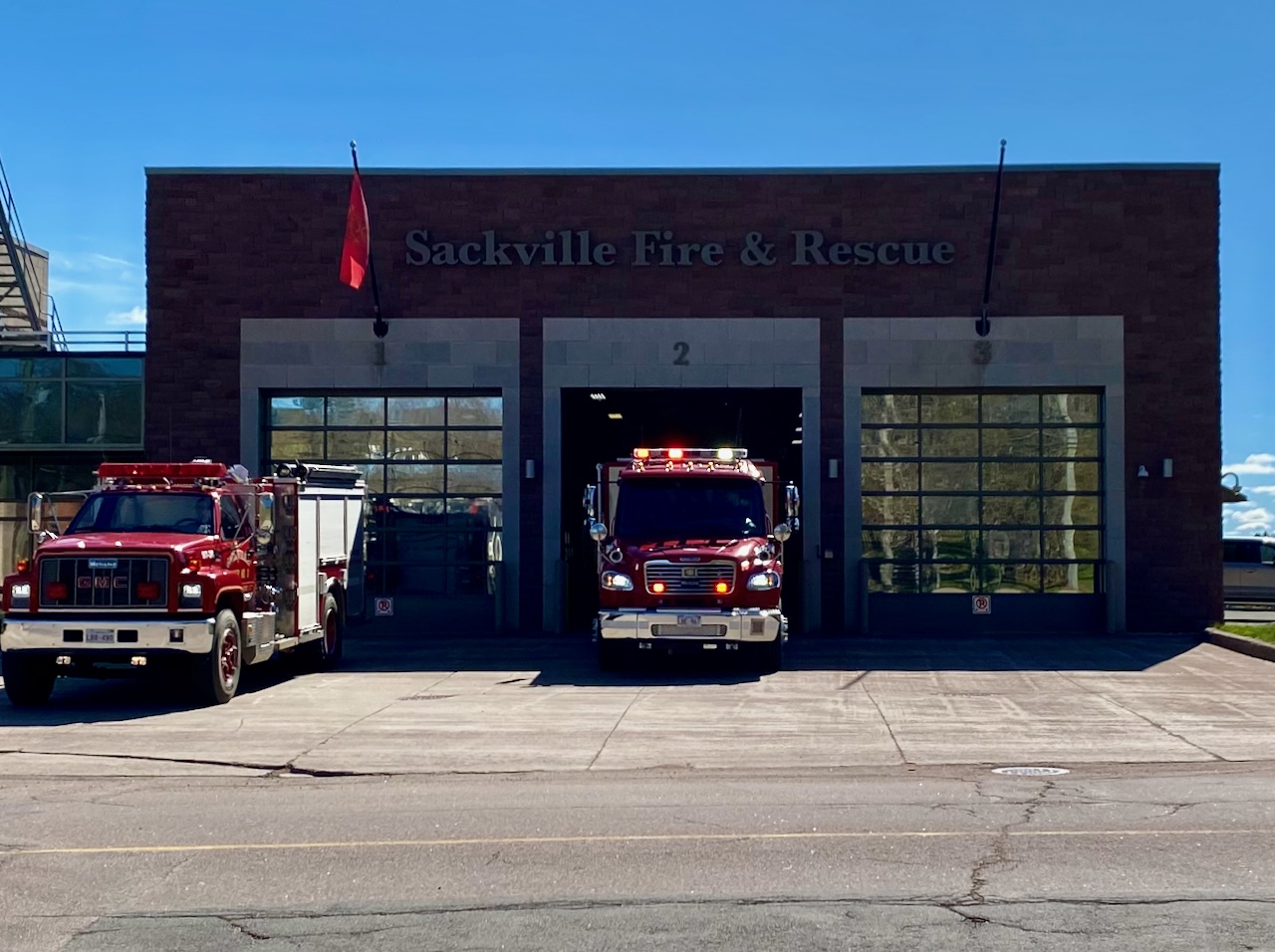
Sackville fire chief says firefighters are ‘tiring’ with record call volumes. Dept. is also under full strength

Councillor Allison Butcher

After hearing about heavy call volumes during a Tantramar council meeting last week, Councillor Allison Butcher  asked a basic question about the Sackville fire department: “Do we have enough volunteer firefighters?”

She was responding to Sackville Fire Chief Craig Bowser’s report that his department responded to 20 calls for service in a one-month period from mid-October to mid-November.

Those calls included nine motor vehicle collisions, four commercial fire alarms, two requests for assistance from Ambulance New Brunswick, one water rescue, one utility pole fire, one vehicle fire, one rubbish fire and one carbon monoxide alarm.

“With so many calls  for service, is this something that we should be having on our radar moving forward that are we starting to outgrow having a volunteer fire station?” Butcher asked.

“Or do we need to enlarge how many fire members we have, or is it all good?” she continued.

Record call volumes

“Just to give you an idea of where we are this year in call volume compared to last year, we’re up 78 calls for the same reporting period,” Bowser answered, adding that in the years before the COVID pandemic, annual call volumes were about 160 to 170.

Sackville Fire Chief Craig Bowser

“Last year was our biggest call volume on record at 223, I believe it was. We’re at 275 calls for service right now,” he said as he predicted this year’s calls would go well over 300.

“So, to answer your questions, our members are tiring because it’s expected of them to train every Thursday night for two-and-a-half, three hours and then respond to all these fire calls,” Bowser said.

“A lot of the calls are nothing in significance, but still, from the time they leave their employer to the time they go back, it pretty well chews up an hour.”

He added that some employers are now reluctant to let staff go until a second alarm has been called to indicate a fire is serious enough to require more volunteer firefighters.

Later during the public question period, Chief Bowser reported that Sackville Fire & Rescue has 35 or 36 volunteer firefighters on its current roster, seven or eight below the full complement of 43.

Long, troubled tale

The department has been unable to recruit enough volunteers to fill its full roster for more than four years after Warktimes first reported that about 17 had resigned over allegations of bullying, harassment and favouritism.

After Warktimes published a second report in which more former firefighters spoke about the persistently low morale in the department, the former town of Sackville hired Montana Consulting to conduct a workplace assessment, but refused to release its report on the grounds that under the law, personnel investigations must remain private.

The former town reclassified volunteer firefighters as part-time employees subject to the town’s social media use policy which bans any commentary that would reflect badly on how the town is run. It also prohibited firefighters from talking to the media requiring them to refer any request for information or comment to the chief.

Sackville brought in a “whistleblowing” policy requiring firefighters to report any activities they considered illegal or unethical to the fire chief, the CAO or the mayor.

New Brunswick’s Ombud upheld the town’s decision to keep the Montana report secret as did the Court of King’s Bench.

And when Councillor Bruce Phinney tried to persuade his colleagues to order release of the Montana report, all but one of them voted no.

Posted in Sackville Fire & Rescue, Town of Sackville, Town of Tantramar | Tagged , | 2 Comments