NB premier stands by decision to slash Green Party caucus budget

Premier Susan Holt answering question on cut to Green Party caucus budget at her news conference last week

Liberal Premier Susan Holt says she has no intention of overriding the work of a legislative committee that decided to slash the Green Party caucus budget by $154,000 and give that money instead to her party’s caucus.

“The decisions on how the opposition and the government members’ offices are funded is a decision of the Legislative Administrative Committee,” Holt explained last week, adding the committee members agreed to a funding formula that they felt “was most equitable and fair across all 49 representatives in the New Brunswick legislature.”

She was responding to a question at her weekly news conference about the potential loss of effective opposition voices in the legislature.

The Greens have been forced to lay off two of their four caucus staff members because of the budget cut.

“There’s clearly an attempt by the Liberals to try to undermine the work that we do in the legislature,” Tantramar Green MLA Megan Mitton said today in a telephone interview.

“It’s frustrating because some of the work that we need to do is to read and research bills,” she added, “so that we are effective in dealing with them at committee.”

Mitton said that she and Green leader David Coon will continue to put in even more hours to do that work.

“I refuse to let them slow us down despite their best efforts,” she added.

She also pointed out that the new budget allocations have nothing to do with the Greens’ loss of one seat in the election last fall because the party’s caucus budget had already been reduced to reflect that loss.

“They’ve taken this further,” she says. “This is clearly an attack on the Greens.”

Cuts to Green statements

MLA Megan Mitton reading a statement in the legislature in 2020

Mitton says that yesterday she was writing a statement to read in the legislature when she learned that the rules had been changed and the time for Green statements had been cut in half, from two per day to one, with that lost time allocated to the Progressive Conservatives.

“What that means is, they’ve taken 40% of our caucus budget and they gave it to themselves, and then they took 50% of our member statements and gave them to the PCs,” she says, adding that those brief, one-minute member statements are important for calling attention to issues that matter.

She says the statement she wasn’t allowed to read yesterday was a follow-up to questions she had asked about how many people apply for social assistance and how many actually receive it.

“I finally got the number and I was shocked,” she says. “More than half of people who call and apply for assistance are screened out as ineligible. It’s like 11,000 people who call and ask for help and don’t get it. And so, I was going to draw attention to how the system isn’t working.”

She says the figures also showed that about 42% of those who apply for disability benefits get rejected.

“I was going to draw attention to how the government is failing thousands of people who are struggling the most.”

Two party system

Mitton says she has made statements every day she was in the legislature since 2018 when she was first elected — statements ranging from expressing concerns about cuts to road maintenance budgets, the rough shape of many roads such as Rte. 955, lack of access to primary health care, the need to reform laws for victims of sexual abuse, inadequate responses to the climate crisis and the urgency of protecting the Chignecto Isthmus from rising seas and violent storms.

“I speak for thousands of people,” she says, “and I was extremely upset yesterday when I learned that the government is trying to silence us.”

She says the all-party committee that decided on the caucus budget cut meets behind closed doors and discussions there are not made public, but she feels the Liberal majority and their PC colleagues were motivated by politics.

“I do think this is an effort to reinforce the two-party system that benefited both the Conservatives and the Liberals, because they basically just passed power back and forth, 100% of the power, you know, every four or eight years.

“And they were quite happy to do it that way,” she says.

Posted in New Brunswick government, New Brunswick politics | Tagged | 7 Comments

Tantramar council hears detailed ideas for developing key economic sectors by 2035

David Campbell, president of Jupia Consultants speaking to town council on Monday

A newly released report recommends that Tantramar focus on developing key sectors such as tourism, the arts, agriculture and health care over the next 10 years to promote a thriving and prosperous economy.

“It’s really just meant as a sort of starting document to get you thinking about the future from a population growth and economic opportunity perspective,” consultant David Campbell told Tantramar Town Council on Monday as he presented highlights from a 35-page report commissioned by the Southeast Regional Service Commission.

The report called “Tantramar A Look Forward to 2035” says the municipality will need to attract more workers to replace just over a quarter of its workforce that is now 55 or older.

Campbell presented a slide showing that compared to Canada as a whole, Tantramar has a disproportionately older population.

The report notes that Tantramar’s population grew by an estimated 11% between 2013 and 2023 to a total of about 9,600, but that more housing will be needed to attract additional workers.

It says the Tantramar workforce is mobile with many workers who live here going out of town to work, with many who live elsewhere, coming in to work here.

The report lists the top employers in Tantramar as: Mount Allison University (925 workers), Dorchester Penitentiary (645 workers), health care and social assistance (560), professional services (300), finance and insurance (300), construction (290), accommodation and food services (280) and retail trade (280).

The report recommends developing key sectors over the next 10 years and presents ideas for how to do it:

Tourism

The tourism industry is important to the Tantramar economy and supports multiple industries including arts, entertainment and recreation; accommodations and food services; and retail trade. The community hosts many festivals and events that draw in people from across the Maritimes and beyond. There are many tourism activities to explore and many attractions. In the years ahead, there could be potential to attract more investment to boost Tantramar’s dominance in the tourism industry.

The tourism industry took a hit during the COVID-19 pandemic, but there are many reasons why the future could hold additional potential for Tantramar. The aging population across North America is expected to give tourism spending a boost over the next 20-30 years. Further, international tourists were a fast-growing segment of traffic pre-pandemic. It is expected to continue rebounding in the coming years. The university is a magnet not only for students but for tourists as well.

Opportunity:Attract more tourism investment to the municipality leveraging the municipality’s existing assets including the beaches and ocean-based tourism. • Continue to expand the season for tourism. Bringing in more tourists in the shoulder seasons would result in more year-round jobs and boost the economy for more than just a few months each year. • Continue to develop events and activities that draw tourists from other parts of New Brunswick, Canada and beyond. Live Bait Theatre and the Mount Allison Performing Arts provide excellent entertainment. • Work with the farming sector to develop agritourism opportunities.

Arts and culture

One of the industries that could hold potential in the future is the arts and culture sector. Tantramar has a vibrant arts and culture scene including art exhibitions, theatrical performances, recitals, concerts, film, festivals, and more. Anchoring the arts and culture sector is Mount Allison University with its many arts and cultural assets. The Owens Art Gallery is the oldest art gallery in Canada. The Brunton Auditorium hosts more than 80 concerts, recitals and guest speakers each year. The 1,500 seat Convocation Hall can accommodate large performances. Adjusted for population size, the municipality is home to more than twice as many companies operating in the arts, entertainment and recreation sector compared to the rest of southeastern New Brunswick. There are four performing arts companies, theatres, heritage institutions, museums and other arts and cultural assets. Tantramar is an ideal location for creators offering beautiful landscapes, water views and other inspiration. 

Opportunity: • Attract more independent artists to the municipality. • Continue to work with the university to expand the arts and culture sector.

Health care 

The Municipality of Tantramar is home to the Sackville Memorial Hospital, an acute care community hospital that serves the population of Sackville, Dorchester, Port Elgin and surrounding areas, including the large student population of Mount Allison University. Health care ranks as the third most important industry in the municipality in terms of employment and revenue (behind education and the penitentiary). However, there could be health care services that are currently offered in the Greater Moncton region but there is enough demand for them to be offered in Tantramar. For example, according to Lightcast, per capita revenue in the ‘ambulatory health care services sector’ was 40 percent lower than the average across southeastern New Brunswick in 2022. Adjusted for population size there are only half as many doctors’ offices and 24 percent fewer dentist offices.

Opportunity:Determine gaps in health care services by surveying residents or other methods. Develop a business case to attract more health care service providers to fill any gaps. 

Farming

According to Lightcast, revenue from the farming sector in Tantramar (including the former parish) exceeded $22 million in 2022. This makes farming one of the most important private sector industries in the municipality. The number of farms in the area is shown in Table 6. In addition to the 37 farms, there are five food manufacturing companies in the municipality including two bakeries, a frozen food manufacturer, a snack food manufacturer and one brewery.

Opportunity: There is an opportunity to encourage more farming in and around the municipality. This would require attracting young farmers to the area and providing them support. There could be more opportunities for small scale value-added food production. Agri-tourism could be developed further in conjunction with the growth in farming. A report prepared for the Southeast Regional Service Commission suggested that agri-tourism revenue could double in the coming years if there was a focused effort.

Personal & professional services

Residents of Tantramar commute into Greater Moncton or Amherst to access a wide variety of services. Based in the number of businesses per 1,000 population, Tantramar could be under-serviced in areas such as legal services, engineering services and financial services. There are 25 percent fewer limited service eating places. There are considerably fewer retail stores (e.g. furniture, building supplies, specialty foods, etc.). This is not necessarily a bad thing. In fact, one of the benefits to being a municipality located adjacent to a larger urban centre is that residents can access a much broader mix of services compared to more remote municipalities. However, if there is enough demand in the municipality for specific stores and services, residents may wish to shop local rather than commute into the urban centre.

Opportunity: Develop a detailed market threshold analysis to determine if there is a business case for specific stores and services to be located in a central part of Tantramar.

To read the full report, click here.

Note: The report is one of 13 that the Southeast Regional Service Commission asked Jupia Consulting to compile for municipalities in southeastern New Brunswick. To read an overview report on the whole region, click here.

Posted in economic development, population growth, Southeast Regional Service Commission, Town of Tantramar | 3 Comments

Mt. A. audience hears how Canada’s ‘settler-colonialism’ explains its support for Israel’s slaughter of Palestinians

Professor Veldon Coburn

Indigenous scholar Veldon Coburn introduced a panel discussion on the similarities between Canada and Israel on Friday with a blunt observation:

“Nobody’s slaughtering my people anymore,” he said. “They’ve taken everything.”

Coburn, whose mother is a status Indian and whose father’s side descended from white settlers, is Anishinaabe, a citizen of the Algonquins of Pikwàkanagàn whose reserve at Golden Lake, Ontario is a mere 6.9 square kilometres.

“That’s what was left for us out of about 145,000 square kilometres,” he told an audience of about 30 in the Windsor Grand Room at Mount Allison University.

He noted that while Indigenous dispossession is all-but complete in Canada, Israel is currently inflicting extreme violence on Indigenous Palestinians in the occupied territories of Gaza, the West Bank and East Jerusalem because it is determined to take their land.

Coburn, who is a professor of Indigenous studies at the University of Ottawa, said that although mainstream media do not show it, the “horrors and atrocities” committed by Israel in Gaza during the past week would turn anyone’s stomach.

“More Palestinian children were killed this past week. It’s incomprehensible and it’s difficult to avoid words like butchered, massacred, slaughtered,” he said as he introduced Jeremy Wildeman and Muhannad Ayyash, co-editors of the 2023 book Canada as a Settler Colony on the Question of Palestine.

Canada’s settler-colonial history

The book argues that in spite of many Canadians’ belief that their country champions democracy, human rights and peace around the world, Canada’s steadfast support for Israel’s dispossession of Palestinians is rooted in its own history as a settler colony whose white European settlers violently displaced Indigenous peoples from their ancestral lands.

“Settler colonialism is, first and foremost, defined by the elimination of Indigenous peoples from the land and their replacement with settlers from elsewhere,” the book’s introduction says.

Professor Muhannad Ayyash

“You can make sense of Canada’s position on Palestine on the very basis of its settler-colonial nature, not just its foundation, but its continuing existing structure today,” said Muhannad Ayyash who was born and raised in Silwan, Al-Quds (Jerusalem) before emigrating to Canada where he is professor of sociology at Mount Royal University in Calgary.

“Canada is completely uninterested in decolonizing this settler colony,” Ayyash said. “It is uninterested in decolonizing Palestine. It is completely uninterested in decolonizing the world imperial order in which Canada plays a supporting role to U.S. imperialism.”

He added that neither Canada nor Israel will ever accept the sovereignty of their Indigenous peoples.

In Canada’s case, he said, it’s safe to talk about truth and reconciliation because its Indigenous inhabitants have been dispossessed of their lands and their sovereign powers.

In Israel’s case, there is continuing fierce political, military and judicial resistance to Palestinian sovereignty.

“They’ve never said Palestinians can have self-determination,” Ayyash said.

“They’ve never officially finalized their borders. Why do you think that is? Because, like, we’re not done. We’re going to take the whole thing.”

Canadian hypocrisy

Jeremy Wildeman, who is a Fellow at the Human Rights Research and Education Centre at the University of Ottawa and who was raised in Treaty 6, in central Saskatchewan, suggested that Canada’s failure to stand up for human rights in Palestine and parts of the world where Canadian mining companies operate, may now be coming back to haunt us as the U.S. threatens to annex the country as its 51st state.

“Anybody who thought we can just ignore human rights and justice because it’s not going to affect us…[and who said] ‘Look, we’re such loyal allies to the United States. We’re such good subcontractors in the American empire’…and now the United States is saying, ‘Actually, you know what? You’re part of us, right?'” Wildeman said, adding that Canadians now feel a strong sense of injustice when Americans talk about tearing up our free trade treaties.

“This is the world we’re entering now,” he said, pointing to one in which Donald Trump threatens to expel Palestinians and turn Gaza into ocean-front beach resorts or take over resource-rich Greenland.

Media biases

Jeremy Wildeman

Both Ayyash and Wildeman agreed with Veldon Coburn that the Canadian media do not tell the truth about what Israel is doing to Palestinians in Gaza and the West Bank.

They referred to a chapter in their book by Rachad Antonius, an Egyptian-born adjunct professor of sociology at the Université du Québec à Montréal.

That chapter analyzes Radio-Canada coverage of Israel’s seven week war on Gaza in July-August 2014.

Among his conclusions, Antonius finds that the coverage from the French-language CBC was framed as a symmetrical contest between equals even though Israel was using one of the world’s most powerful militaries to attack a tiny, densely-populated territory that has primitive defences with no air power at all.

“Israel is in a position of self-defence, and Hamas is to blame,” he writes about media portrayals. He adds that Israeli justifications are given prominence while Palestinian perspectives are ignored or downplayed and that coverage explains military violence as a response to earlier military violence, not as a response to Israel’s occupation and its ongoing naval, air and ground blockade of Gaza.

And while “Palestinian suffering is amply represented,” coverage again follows the Israeli narrative of blaming Hamas for it.

Finally, Antonius argues that Radio-Canada coverage reflects Canada’s official position on Israel/Palestine and that any change “would put the CBC and its journalists on a collision course with its funders, the Canadian government, and with the Canadian political elite.”

During the panel discussion, Muhannad Ayyash said it is not bad journalism that is to blame for biased coverage. It is a structural bias arising from the mindset of settler colonialism.

“Canadian mainstream media, like American mainstream media, UK, any Western European onwards, they know that they’re not telling the truth on Palestine. Let me just be very clear about that. They’re not stupid. They know they’re not telling the truth,” Ayyash said pointing out that hundreds of Canadian journalists, including those working for CBC, have complained publicly about the lack of honesty and objectivity in reporting on Palestine/Israel.

“If you really don’t want to know what’s going on in the Middle East, watch the CBC or the BBC,” Wildeman said as the audience laughed.

To read a detailed report on the CBC journalists complaining about biased Middle East coverage that was featured in The Review of Journalism at Toronto’s Metropolitan University, click here.

For a transcript and analysis of a recent CBC Radio story on coverage of Israel’s war on Gaza, click here.

To order a copy of Canada as a Settler Colony on the Question of Palestine from Tidewater Books, click here.

Posted in Mount Allison University | Tagged , , | 13 Comments

Sackville open house hears strong opposition to proposed Rogers cell tower

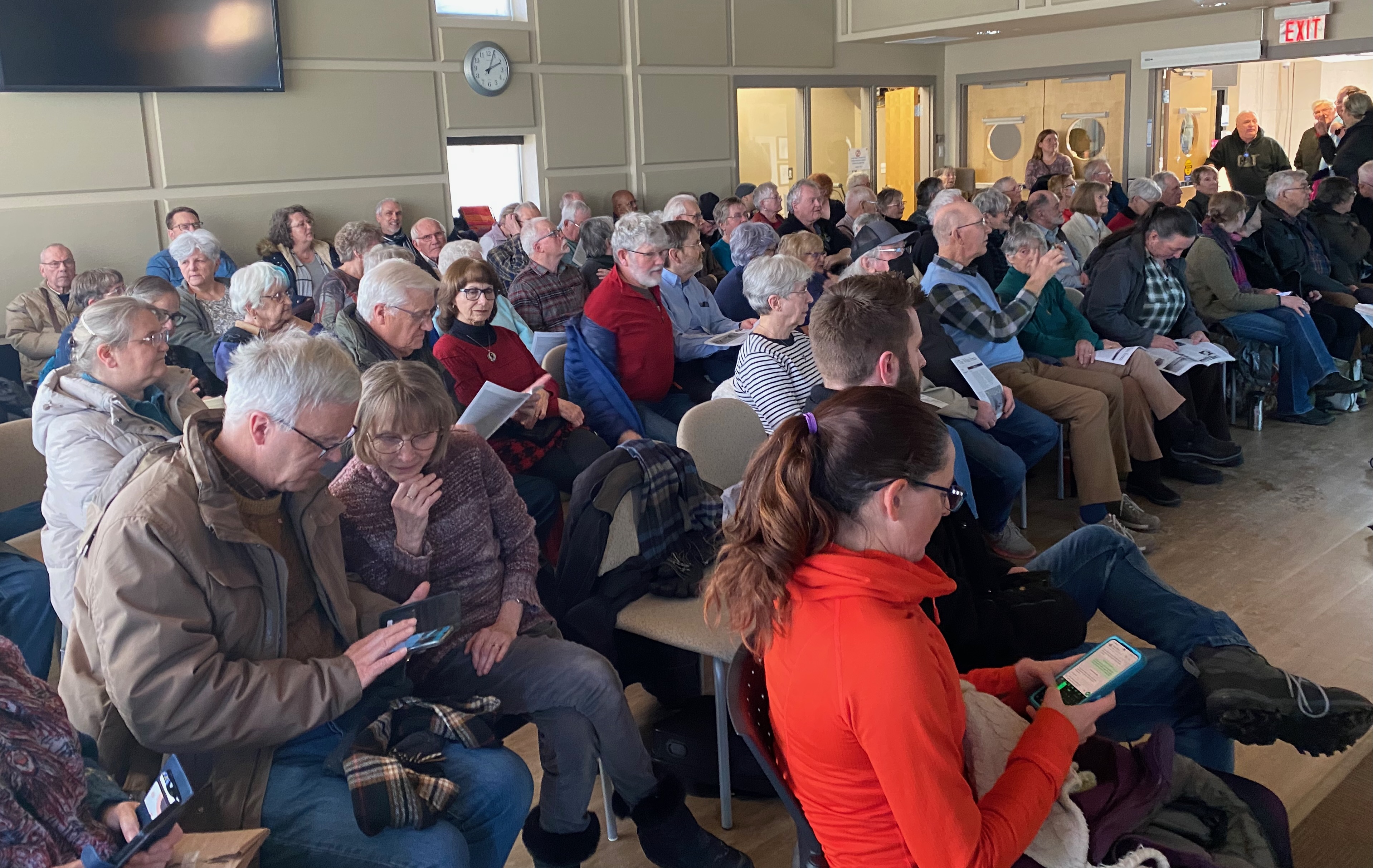
Screen shows agent Michelle Klein, (upper right) Chris McDonald of Rogers., (lower left), a blank square representing Ben Van Reekum of Scott Telecom (lower right) and audience members (upper left)

About 25 people attended a meeting on Tuesday where residents expressed strong opposition to a proposed 65-metre (213 foot) Rogers cell phone tower at 14 Crescent Street in Sackville overlooking one of the town’s new water retention ponds and the walking trails around it.

“While the other providers such as Bell and Eastlink have more infrastructure in the area, Rogers currently has fewer towers, which results in many areas with weak or no service,” said Michelle Klein of Scott Telecom Services, the company that is acting as an agent for Rogers Communications Inc.

“This is especially important for critical services like EMS (emergency medical services), police, fire, rural broadband and everyday communication like voice, data and streaming,” Klein added in her online presentation from Calgary that was projected on a screen at the Civic Centre.

“I’m wondering why this tower has to be at 14 Crescent Street and not somewhere away from where people live,” asked Sackville resident Meredith Fisher referring to nearby homes on Beal Heights.

“It’s right in the centre of our town,” she said. “It’s going to be a contentious issue.”

Klein replied that her company selected the site because it’s zoned industrial and has ready access to electric power.

Her colleague Ben Van Reekum said the company has been working on the site’s technical specifications for several years after finding that there wasn’t room for a tower in the vicinity of Mount Allison University.

“There are many considerations: zoning, space…power, access, etc. and this location fit all of those as well as having a willing landlord,” he added.

Rogers is leasing the site from Sackville resident Percy Best who also attended Tuesday’s meeting.

The cell tower is across from the Armtec pipe plant, beside the CN rail line and overlooking the newly constructed Lorne St. water retention pond. Source: Rogers Communications

Kathleen Trites, a dental hygienist who works on Allison Avenue, said she puts lead aprons on her patients to protect them from tiny amounts of radiation when they get X-rays.

“What are people going to do, walk around with lead aprons all the time?” she asked referring to studies on the health effects linked to radio frequency (RF) radiation from cell towers.

Trites warned that children at the nearby Marshview Middle School would be at risk of thyroid cancer.

“Canada has very strict regulations for RF energy including Health Canada’s Safety Code 6“, Klein told the meeting.

“Safety Code 6 is based on scientific research and it aligns with international standards,” she added. “Health Canada ensures that RF levels from towers remain well below safe limits for human and wildlife exposure.”

However, Klein’s assurances did not seem to convince other residents who spoke.

Jean Cameron speaking to Michele Klein as audience members listen. Photo: Erica Butler

Retired physician Jean Cameron expressed a number of concerns pointing out that the area is subject to flooding worsened by rising sea levels and potential dyke breaches as well as hurricane-force winds from the Bay of Fundy as ocean temperatures rise due to climate change.

She also said that a cell tower that tall could affect migrating birds and wondered why Rogers would not consider locating it on the Tantramar Marsh where CBC shortwave  towers once stood or on the nearby site of the Enterprise Foundry less than a kilometre away.

“This is a difficult decision I know for you folks to make, but it’s also very important to us as residents,” said former Sackville mayor Pat Estabrooks who also expressed concern about potential health effects.

“I live on Beal Heights, so that tower will be directly behind our home,” she added.

“It’s not the right place to put it…[and] I just want to tell you you’re making a wrong decision.”

When asked about next steps, Klein explained that after public consultations are complete, she will write a report for the Southeast Regional Service Commission’s municipal planning department known as Plan 360.

“It will include every comment that we’ve received, not from the open house tonight, but it will include every comment that has been e-mailed in and my response to the comment,” she said.

“After that, it will be up to Plan 360 to issue a letter of concurrence or non-concurrence. And, at that point, we review the file and if we have our letter of concurrence, then we move forward with building a tower.”

For previous coverage, click here.

Posted in Environment, Town of Tantramar | Tagged , | 11 Comments

Tantramar council gives preliminary approval to contentious code of conduct

Councillor Debbie Wiggins Colwell voiced concerns about 90-day suspensions

In a narrow 5-4 vote, Tantramar council gave preliminary approval (first reading) Tuesday to a revised code of conduct bylaw that would give members the power to suspend one of their colleagues for up to 90-days without pay.

“Remember this is first reading,” Mayor Andrew Black told council. “You still have another two readings, so there’s still opportunity for conversation.”

Black made the comment during a 19-minute debate in which the four councillors who voted against approving the revised bylaw, expressed concerns about the 90-day suspension as well as a provision that says members of council must “avoid forming ‘alliances’ with other councillors for the purpose of controlling council meetings, agendas or outcomes.”

“I definitely have no objections to the code of conduct. We do need the code of conduct,” said Councillor Debbie Wiggins-Colwell, adding however, that a 90-day suspension is a “heavy-handed” penalty.

She argued it would mean that wards with only one councillor such as Dorchester, Point de Bute and Westcock could lose their representation on council for up to three months.

“I represent everyone within our municipality,” countered Ward 3 Councillor Allison Butcher emphasizing that she does not only represent residents in the former town of Sackville where she was elected.

“We all represent everyone and someone who lives in Point de Bute can contact me if they have a problem,” she said.

Councillor Josh Goguen

Meantime, Councillor Josh Goguen took aim at the prohibition on forming alliances with other members.

“If I’m putting forward a motion and I go talk to the councillors and I say, ‘I want your support’ that could be considered as an alliance,” he said, adding the provision is open to differing interpretations.

Councillor Michael Tower said that while he agreed with the 90-day suspension without pay for “rogue” councillors, he too was concerned about the provision against forming alliances because it could discourage members of council from enlisting support from their colleagues.

“I really think alliances or conversations are consensus building,” he said.

Councillor Barry Hicks suggested that the town consult experts on municipal politics such as Mount Allison Professor Geoff Martin on what needs to be in a code of conduct bylaw.

(Martin, who served for six years as a municipal councillor in Sackville, told Warktimes recently that the draft of the revised code of conduct bylaw would violate Charter rights to free speech and free association.)

In the end, Mayor Black, Deputy Mayor Greg Martin and Councillors Butcher, Tower and Matt Estabrooks voted in favour of first reading while Councillors Bruce Phinney, Wiggins Colwell, Hicks and Goguen voted against.

Other Canadian provinces

Only three other provinces in Canada have regulations allowing for suspension of municipal council members for violating council codes of conduct:

  1. Newfoundland and Labrador: up to 3-month suspension

2. Prince Edward Island: suspension of the council member for a maximum of 6 months

3. Quebec: up to 90-day suspension

Three provinces have policies that explicitly prohibit such suspensions:

1. Ontario: penalties must not prevent council members from carrying out their duties

2. Saskatchewan: Statement from provincial minister of government relations (2023): Council members are ultimately accountable to the people who elect them. Voters make the decision on whether or not to re-elect a council member if they choose to run again for office. Removing a council member from that position before an election interferes with the democratic will of voters who put them there. Therefore, any action that effectively results in the removal from office would be undemocratic.

3. Alberta: Council may not impose any sanction that prevents a councillor from fulfilling the legislative duties of a councillor. Further, a councillor may not be disqualified and removed from office for a breach of the Code.

Note: As the debate over Tantramar’s revised council code of conduct continues, the municipality of Strait Shores has suspended a newly elected councillor indefinitely.

For the latest coverage from CHMA reporter Erica Butler, click here.

For CBC coverage, click here.

Posted in Town of Tantramar | Tagged | 2 Comments

Court records reveal Sackville managers’ legal battle to keep their jobs in Tantramar

Two senior managers who worked for the Town of Sackville filed separate lawsuits in 2022 and 2023 challenging their removal from their jobs in the newly amalgamated municipality of Tantramar, according to court records in Moncton.

Chief Administrative Officer Jamie Burke launched his case against the provincial government in October 2022 after he lost the competition for the Tantramar CAO’s job to Dorchester’s CAO Jennifer Borne.

Sackville Treasurer Michael Beal sued the province and the new municipality in March 2023 after he was appointed director of the newly created department of corporate compliance instead of keeping the treasurer’s job he had been doing for Sackville since 1999.

Files in the Court of King’s Bench show that both Burke and Beal withdrew their cases after reaching out-of-court settlements.

Jamie Burke’s case

In his court filings, Burke asks the court:

  1. to overturn the minister of local government’s decision to appoint Jennifer Borne as Tantramar’s new CAO as well as his decision to deny the job to Burke
  2. to declare that the Minister, Daniel Allain failed in his obligation to provide procedural fairness in finding that Burke was not suitable for the position without giving him a fair and unbiased opportunity to present his application during his job interview
  3. to declare that Jennifer Murray Consulting, the firm hired to oversee the job application and interview process, conducted the process improperly without procedural fairness and with bias against Burke and in favour of Borne
  4. to award Burke legal costs

Sackville CAO Jamie Burke

In a sworn affidavit, Burke states that he was “excited for the opportunity” to compete for the Tantramar CAO job.

“I worked carefully to craft my application,” he says, adding: “I also worked on a PowerPoint presentation which would form the main portion of my presentation.”

He goes on to say that during his interview at the Coastal Inn on June 8, 2022, he was not given a “proper opportunity” to present his PowerPoint and that he was “put at a significant disadvantage” compared to the other candidate.

“Shortly after my interview, Andrew Black, a member of the Human Resources subcommittee, resigned from his position as a result of the interview and candidate evaluation process,” Burke’s affidavit says.

For Warktimes coverage of Black’s resignation from the subcommittee as well as the Town of Sackville’s formal request for an independent review of the hiring process, click here.

For Warktimes coverage of the minister’s decision not to grant the town’s request for an independent review, click here.

Burke’s affidavit says that Chad Peters, the business consultant the province hired to create the new municipality, offered him a demotion to the post of Deputy CAO or suggested he might apply for a job as Chief Executive Officer of the Regional Service Commission based in Sussex.

“I reminded Mr. Peters that I lived in Sackville and my wife was a professor at Mount Allison University in Sackville. Accordingly, moving was not an option for our family.”

An exhibit filed with the affidavit shows that Peters also suggested Burke could apply for CAO positions in the southeastern New Brunswick municipalities of Maple Hills, Butternut Valley and Fundy Albert.

Sackville Town Council accepted Burke’s resignation on October 27, 2022.

He began a new job in January 2023 as an urban planner for the big, professional services company Stantec where he is still employed.

A letter in the court file from Burke’s lawyer dated February 2, 2023 says Burke and the province have resolved outstanding issues and he is withdrawing his case.

In an e-mail to CHMA reporter Erica Butler, Burke says he is unable to comment on his case and how it was resolved.

Michael Beal’s case

Sackville Treasurer Michael Beal in June 2022

In his sworn affidavit dated March 10, 2023, Michael Beal states he attended a meeting with Tantramar’s new CAO Jennifer Borne and transition co-ordinator Chad Peters in December 2022, just weeks before municipal amalgamation would take effect on January 1st.

“During the Meeting, Mr. Peters and Ms. Borne advised me that my position as Treasurer of the Town of Sackville was being revoked and/or eliminated, effective December 31, 2022 and that I was not being appointed as the Tantramar Treasurer.”

The affidavit says Peters and Borne told him he would be appointed instead to a newly created post as director of corporate compliance.

“As Treasurer for the Town of Sackville for over 29 years, I have developed an intimate understanding of the required and prescribed tasks, responsibilities and duties of a municipal treasurer and how to be successful in this position.”

Beal points to several “excellent performance reviews” from past Sackville CAOs that are included in his court filings as well as to his service several times over the years as Acting CAO while also performing his duties as treasurer.

“As Treasurer, I took great pride in serving my community and keeping the Town of Sackville’s finances healthy. I truly loved working as Treasurer for the Town of Sackville and have always felt that accounting and finance are my callings.”

Beal points out that under New Brunswick’s local governance act, his position as treasurer was classified as an officer “entitled to hold office until retirement, death, resignation, or dismissal for cause after a vote in favour of the dismissal by two-thirds of the council members.”

But he was unable to obtain a written employment agreement for the corporate compliance position and could not ascertain whether he would have the same job protections he had as Sackville’s treasurer.

At the same time, he continued to perform duties as Tantramar’s treasurer because the town had not hired a new director of financial services.

“But for my continued service as a Treasurer for Tantramar, and the corresponding accounting and financial services that I render, the municipality would be unable to function properly,” his affidavit states.

In his court filings, Beal also asks for his legal costs to be covered.

Tantramar council approved his appointment as treasurer in April 2023 and Beal withdrew his lawsuit on July 11th.

He responded to an email from Warktimes asking about his case and his out-of-court settlement:

“This court action was filed in order to meet my 90-day time limit in order to protect my legal interest with regards to employment law and time limits.  After my appointment to a similar employment status under the Local Governance Act; there became no need to continue the claim and it was withdrawn. I am satisfied with the outcome.”

To read CAO Jennifer Borne’s description of the director of corporate compliance position, click here.

Warktimes and CHMA FM worked together on this story. To listen to CHMA journalist Erica Butler’s report, click here.

Posted in NB Municipal Reform, Town of Sackville, Town of Tantramar | Tagged | 3 Comments

Mt. A. prof blasts draft code of conduct as violation of Tantramar councillors’ right to free speech

Mt. A. Politics Professor Geoff Martin

Mount Allison Politics Professor Geoff Martin says the draft of a newly revised code of conduct presented to Tantramar council on Monday violates Charter of Rights guarantees of free speech and freedom of association.

“I think these codes of conduct are becoming too overbearing,” Martin said Thursday during a telephone interview with Warktimes.

“I’m not convinced it should be within the power of council to suspend someone without pay, for example, for any length of time.”

Martin, who specializes in the study of municipal politics and who served on Sackville town council himself from 1998 to 2004, was referring to a provision in the newly revised code that would allow a majority on council to suspend a member without pay for up to 90 days.

Provincial regulation

During Monday’s meeting, Town Clerk Donna Beal said a revised code of conduct bylaw is needed to comply with a new provincial regulation that specifies what should be in it.

Town Clerk Donna Beal

“No matter what else is in the bylaw, those things have to be included,” Beal said, referring, for example, to a new provision requiring members of council to “adhere to core values of honesty, integrity, objectivity, impartiality, and accountability.”

Another new provision states: “No Councillor shall make a statement that the member knows or reasonably ought to know is false or misleading…”

It appears, however, that the stiffer penalties, such as the 90-day suspension without pay are optional and may or may not be included in the new bylaw although they do appear in the draft that town staff are recommending council approve at future meetings.

“I really speak for staff that we do not want to be involved in policing council,” CAO Jennifer Borne explained during Monday’s meeting.

“It’s a very challenging situation for council to police themselves,” she said, adding that applies to every municipal council in New Brunswick.

Free speech

Councillors Debbie Wiggins-Colwell and Bruce Phinney, who have both been found guilty of violating past codes of conduct, voted against sending the bylaw to the next regular council meeting on March 11th for first reading.

“Before approving this bylaw, I would like to have a lawyer who specializes in the Charter of Rights and a political science professor to explain how implementing this would not infringe upon our freedom of speech or expression, which now more than ever we need to protect,” Wiggins-Colwell told council.

Councillor Bruce Phinney

She added that she fears democracy is undermined when government regulations prescribe what elected officials can or cannot say.

“I just feel that it’s taking away anything we wish to say because, as we all know, we can read this, but we can all interpret it in our own way,” Councillor Phinney said.

“I want to make it clear that the code of conduct does not muzzle councillors,” said Mayor Andrew Black.

“It does not keep you from saying what you want to say,” he added.

“What it does do is make sure that you don’t say what you shouldn’t say,” Black said referring to a provision that prohibits members of council from making “a statement that is defamatory to a member of Council, an officer or employee of Tantramar or a member of the public.”

The mayor said that provision is meant to protect the municipality from potentially costly lawsuits.

Councillors Michael Tower, Josh Goguen, Matt Estabrooks and Allison Butcher spoke in favour of the revised bylaw.

“This to me, looks like it’s in place to protect us,” said Councillor Butcher. “I look at this as a very positive thing.”

Enforcing conformity

But Politics Professor Geoff Martin disagrees.

“These codes of conduct can easily be used by municipal staff and to some degree, the mayor, to enforce a certain conformity,” he says, adding that the sections on free speech are open to interpretation.

One provision of the present code of conduct, for example, says councillors shall use “communication tools and social media in a professional and appropriate manner only to promote the approved objectives of Council and not to attempt to reflect on Council decisions or disparage or criticize other Councillors or staff.

“Derogatory, defamatory, discriminatory, indecent, obscene or false comments shall not be posted on any social media account, including, without limiting, any posts made anonymously.”

Martin says such provisions can be used to suppress legitimate dissent and political independence.

He’s especially concerned about an existing provision that says members of council “shall avoid forming ‘alliances’ with other Councillors for the purpose of controlling Council meetings, agendas or outcomes.”

“This is ridiculous,” Martin says. “It’s the most foolish thing I’ve ever seen.”

He wonders if there’s any law in New Brunswick that would prohibit municipal candidates from forming a slate to push for common goals.

“How are they going to determine who’s in an alliance?” he asks.

“I think this is a clear violation of the Charter right of freedom of association,” he says.
“If you want to write that I’m blasting this code of conduct, go ahead. Yes, I am blasting it.”

To read, Town Clerk Donna Beal’s presentation to council and the new draft bylaw, click here.

To read coverage of Councillor Wiggins-Colwell’s Code of Conduct violations, click here.

For coverage of Councillor Bruce Phinney’s violations, click here.

Posted in Town of Tantramar | Tagged , | 3 Comments

Mayor Black calls on Rogers to reconsider location for cell tower near homes & downtown pond

Mayor Andrew Black addressing council yesterday on the proposed Rogers cell tower

Tantramar Mayor Andrew Black says he’s firmly opposed to the construction of a 65-metre (213 foot) telecommunications tower next to one of Sackville’s stormwater retention ponds.

In a letter to Rogers Communications, Black asks the company to reconsider the location at 14 Crescent Street across from the Armtec pipe plant and near homes on Beal Heights.

“We are deeply concerned about the potential negative impacts this tower would have on the health of our residents, their property values and their overall quality of life,” his letter says.

It encourages Rogers “to hold a public meeting to address resident concerns and consider a more suitable site for this project.”

‘Beautiful gem’

During Monday’s town council meeting, Black said he had received about 50 calls from concerned residents.

He noted that all levels of government have spent $17 million on the flood control system that also serves as an extension of the Sackville Waterfowl Park with walking trails and natural flora and fauna.

“[It’s] a beautiful gem that will only continue to get better as more and more trees grow and more animals move in,” Black said.

“We will have a…Rogers tower right next to it, which I personally find offensive.”

Black said that Town Planner Lori Bickford told him the municipality can’t do anything because cell towers are under federal jurisdiction and the province does not have rules preserving view planes around them.

Under federal rules, the company is required to submit a plan to the town, notify nearby residents and consider the community’s views.

Rogers response

When asked for comment today on Mayor Black’s letter, a Rogers spokesperson e-mailed the following response:

“We are committed to delivering a reliable, consistent wireless experience and are looking to enhance our network in Sackville to provide more seamless coverage for residents, businesses and emergency responders. We want to ensure our services, equipment and design meet local needs, and we will continue to work with the community.”

The company also said that it works closely with the federal regulator to make sure its products and services meet rigorous safety standards including Health Canada’s Safety Code 6.

Rogers says the public can provide written comments by the end of the business day tomorrow, February 26th. (For contact information, click here.) NOTE: THE DEADLINE HAS NOW BEEN EXTENDED TO MARCH 12TH.

To read the mayor’s letter, click here.

Posted in Town of Tantramar | Tagged , | 10 Comments

Losing CBC coverage would be disastrous for New Brunswick

Conservative leader Pierre Poilievre in 2023. Photo: Wikimedia Commons

Federal Conservative leader Pierre Poilièvre’s threat to cancel CBC’s annual Parliamentary grant would, if implemented, be a disaster for smaller, rural provinces like New Brunswick where local news coverage is already on its way to the morgue.

Federal Heritage Minister Pascale St-Onge issued a series of half-hearted proposals this month for strengthening the public broadcaster in the interests of national sovereignty and combatting the pervasive influence of U.S. tech Goliaths such as Facebook, Google and X.

But hostile federal Liberal and Conservative governments have relentlessly weakened the CBC with a 45-year string of budget cuts starting with Pierre Trudeau’s 12.3% cut in 1979-80. (See Knowlton Nash: “The Microphone Wars: A History of Triumph and Betrayal at the CBC,” page 440.)

In 2020, the non-profit Forum for Research and Policy in Communications calculated that Parliamentary funding for CBC’s operations had decreased in real, inflation-adjusted dollars by 36% since 1985, while CBC commercial income had fallen by 40% since 2014.

In its 2022 report commissioned by the CBC, the international consulting firm Nordicity concluded that Canada ranks near the bottom when it comes to Parliamentary funding for public service broadcasters (PSBs) at $32 per capita.


Poilièvre portrays defunding CBC as an exercise in cutting waste, but a Parliamentary grant of $1.4 billion is not even a drop in the ocean when measured against the $449.2 billion the federal government is spending this year.

CBC is by far, Canada’s largest journalistic organization with community-based locations from coast-to-coast-to coast including 27 TV and 88 radio stations as well as local and regionally based online platforms in every province and territory.

(In 1994, New Brunswick was the last province in Canada to receive full CBC television service thanks to the efforts of Premiers Richard Hatfield and Frank McKenna who wrested the partial service we were getting away from the Irving empire — paid from public coffers to carry a few hours a week of CBC programming on their private broadcast outlets.)

Nowadays, only two big journalistic outfits have outlets that are based in New Brunswick: CBC and the American-owned, Postmedia newspaper chain (which cut about half of its editorial staff after buying the Irvings out in 2022).

CTV and Global do provide some New Brunswick coverage from headquarters that are out-of-province.

In spite of Poilièvre’s constant harping on defunding CBC, a poll of 2055 Canadians conducted from August 28 to September 6 found that an overwhelming majority said they need the CBC. The poll was sponsored by The Centre for Media, Technology and Democracy at McGill University:

Poilièvre’s threat to erase Canada’s largest journalistic organization comes as other, like-minded politicians take calculated steps to sidestep scrutiny.

In Nova Scotia, Conservative Premier Tim Houston, in one of many anti-democratic moves, is dismantling the province’s communications agency that was supposed to provide journalists with factual information from every government department.

Henceforth, all inquiries will have to be funnelled through the premier’s office and by decree, no more media questioning of the premier and his ministers outside the legislative chamber, but only in the “media room” across the street where reporters may or may not get access to the power holders.

And perhaps worst of all, the Houston government is giving itself the power to obstruct freedom of information requests that both journalists and members of the public rely on to ferret out frequently hidden facts.

Meantime, in New Brunswick, reporters are forced to file access to information requests that take from weeks to months to get even partial answers and sometimes no answers at all.

Why is one lane of Sackville’s Main Street highway overpass still closed after recent attempts to repair the bridge? Repeated inquiries to communications staff at the N.B. department of transportation go unacknowledged and unanswered even when the minister’s office is copied.

And at the municipal government level here in Tantramar, question periods have been reduced from three per month to one and strictly limited to 15-minutes.

And was Mayor Black really serious when he told reporters that he would only answer questions e-mailed to him in advance?

Posted in Commentary, Media, New Brunswick politics, Nova Scotia Government, Town of Tantramar | Tagged , , , | 4 Comments

From sandstone extraction to wilderness park, Sackville’s Pickard Quarry now and then

Around 75 people packed the visitor’s gallery at Tantramar Town Hall on Saturday to hear about the natural beauty of Sackville’s new quarry park and to learn about the Pickard Quarry’s history of producing the high-quality red sandstone used in many buildings at Mount Allison University and across eastern Canada.

“It’s a great crowd and I’m also very pleased that we have so many people in our community who are interested in the history and the future of the Pickard Quarry,” said wildlife biologist Richard Elliot as he thanked people for attending on behalf of the Tantramar Outdoor Club, the Tantramar Heritage Trust and the Chignecto Naturalists’ Club.

He explained that the Pickard family extracted huge blocks of sandstone from the quarry — at times up to 800 tons a day — from the 1880s to 1930 when it was purchased by Mt. A.

The university continued extracting stone for its campus buildings until the late 1970s when the quarry finally closed.

Sackville Freestone Company — image of an unidentified man standing near blocks of quarried stone sometime between 1900 & 1930. Photo: Mount Allison University Archives

“It’s been over 50 years since stone was taken out of that quarry and in that period, it’s really developed into what I call a naturalized wooded area and wetland,” Elliot said, adding that its network of footpaths and its ponds have been used for hiking, viewing wildlife, bird watching, swimming and skating.

“You can see in this picture,” Elliot said pointing to a slide, “my skates and the tracks of an otter on the ice on the same day…

“And anybody who went to high school here or to Mt. A. probably knows that it was a hangout for many nefarious activities,” he added, as audience members laughed.

Later, he referred to a wildlife study he and his partner Kate Bredin updated two years ago in which they found an estimated 49 bird species that nest in the quarry and about 90 species that can be seen there throughout the year. In addition, more than 20 species of mammals may frequent the area.

Aerial view of Pickard Quarry from the east showing the gravelled Quarry Lane flood control structure (bottom), Dominican Dr. & Charlotte St. (left), West Ave. (top). Photo: AN Media for Town of Tantramar

Elliot noted that in 2022, Sackville bought the quarry from Mt. A. for $1 so it could use its pond for retention of stormwater as part of its flood control system.

And then, at the urging of the outdoor club, naturalists and the heritage trust, the town agreed to help them create a wilderness park in downtown Sackville.

So far, a small parking lot has been built off Charlotte Street that leads along a gently sloping trail to a wheelchair-accessible wooden look-out over the south pond. There’s  also a nearby wooden bridge over the waterfall at Bowser Brook and plans call for a series of marked trails with guardrails and steps where they’re needed.

Elliot said there will also be several interpretive signs about the park’s natural features and quarry history.

Last year, the town spent just over $42,000 of the $65,000 capital budget allocated for the project. It has also received a $38,500 contribution from the province and another $25,000 from Medavie Blue Cross.

“We’ve got about a thousand metres or one kilometre of trails in there now,” Elliot said, “so it’s not a big long hiking area, it’s a meander kind of place, but the topography there ranges from pretty flat to very rugged…I would encourage people to keep in mind this is a work in progress.”

Quarry history

Paul Bogaard of Tantramar Heritage Trust showed slides tracing the history of the Pickard Quarry as a well-equipped industrial site that extracted red sandstone blocks from the 50-acre farm that Thomas Pickard had bought from the Bowser family in 1869, the same year he resigned as a mathematics professor at Mt. A.

Bogaard’s detective work suggests that the quarry’s sandstone was used to build Mt. A.’s first stone building in 1883 appropriately called Stone College, but later renamed Centennial Hall.

Unfortunately, construction records were destroyed when it burned in 1933.

Today, the rebuilt Centennial Hall houses the university’s senior administrative staff.

Centennial Hall in May 1887 with students posed in front. Photo: Mount Allison University Archives

Bogaard has written an extensive history of the quarry for the November 2024 issue of The White Fence, the newsletter of Tantramar Heritage Trust.

It lists several other Mt. A. buildings constructed out of Pickard Quarry stone including Hart Hall (1909), the now demolished Memorial Library (1926) and the New Science Building (1931) that is now known as the Flemington Building.

The New Science Bldg., now known as the Flemington Building around the 1930s. Photo: Mount Allison University Archives

In the years before concrete became a prevalent building material, high-quality Pickard Quarry sandstone was used in many buildings in eastern Canada such as Customs Houses in Halifax and several in Ontario including in Waterloo, Hamilton, London, Chatham and Fort William (now Thunder Bay).

The Dominion Observatory in Ottawa and the new wing of the Ontario Legislative building in Toronto were both made of Sackville sandstone as was the Bank of Nova Scotia in Truro, the old Royal Bank in Sackville, the Bank of Montreal in Moncton and the People’s Bank in Fredericton.

Bogaard said much of the credit goes to Charles Pickard who has been described as a “shrewd businessman.”

“He was lucky enough to have very high-quality stone,” Bogaard said.

“The sandstone was very even. It did not have imperfections. The thousandth block looked like the first block, so an architect could count on what it was going to look like aesthetically [and] the strength of it was unusual,” he added.

Bogaard also mentioned Pickard’s investment in powerhouses with steam boilers and electric dynamos to drive stone saws and drills and to power the pumps that kept water from filling excavation sites.

He showed a slide of four derricks, one of them 82 feet high, supporting cranes able to lift blocks of stone weighing up to 30 tons.

He added that Pickard cut costs by hauling stone by rail to Cape Tormentine where it was loaded onto boats for the journey through the Gulf and up the St. Lawrence River and into the Great Lakes.

“All the way through Ontario, from west to east, and in Montreal, and elsewhere in the Maritimes — Halifax, Saint John, Moncton, as well as Mt. A.,” Bogaard said.

“It was those investments that made them compete.”

Paul Bogaard (L) & Richard Elliot preparing to talk about the past and future of Sackville’s Pickard Quarry

To read more about the Pickard Quarry from Tantramar Heritage Trust, click here.

Posted in Town of Sackville, Town of Tantramar | Tagged | 1 Comment

Sackville Rotary Club raises over $1 million in Gold Mine lottery

Sackville Rotary Club member Louise MacKinnon

A past president of the Sackville Rotary Club says that over the last decade, its weekly Gold Mine toonie draw has raised more than $1 million with half of that money going to winners and the other $500,000 awarded to a wide range of community projects.

“We started with just 500 players and now we have close to 3,000 registered members,” Louise MacKinnon told Tantramar Council during a five-minute presentation on Tuesday.

“Funds have been dispersed to our local schools, our hospital foundation, food banks, fire departments and other sporting and charitable organizations,” she said.

MacKinnon also listed numerous projects that the Sackville Rotary Club has supported including a $50,000 bridge linking Sackville’s Waterfowl Park with the 20-acre park extension donated by the late Daniel Lund.

“At Tantramar High, we give annual scholarships,” she said. “We provided laptops for the computing labs, funding for an environmental conference and food pantry donations.”

She mentioned that at Marshview Middle School, the Rotary Club purchased ukuleles and at Salem Elementary supported a program to feed hungry kids on weekends.

After listing dozens of contributions over the last 10 years, MacKinnon said these were just a fraction of the projects that the Rotary Club has supported with its Gold Mine lottery.

Club history

MacKinnon’s presentation came as the Sackville Rotary Club approaches the 94th anniversary of its founding in April 1931 by a group of 17 business and professional men.

Charlie Scobie outside Anderson Octagonal House in 2018

A history of the club, written by Charles Scobie, points out that most Rotary meetings feature a guest speaker and, in the early years, there were also occasional debates.

On April 17, 1933, for example, members debated the motion: Resolved that Music has been and will be of more benefit to the human race than Medicine.

“Of more than passing interest,” Scobie writes, “was a debate on 26 April 1939 on the topic, Should Canada have a national flag? Although Mount Allison faculty member Dr. George F.G. Stanley was a Rotarian at the time (he had joined the club in November 1937) the weekly newsletter does not record his participation in the debate.”

Scobie goes on mention Stanley’s role in designing the Canadian Maple Leaf flag that was adopted in 1965.

Lillas Fawcett Park

His history notes that in 1947,  Rotary members began discussing the need for a recreational site where young people could swim, but it was not until the late 1970s, that the club bought a waterfront site on Silver Lake from Frank Fawcett for $10,000 (with the town contributing $2,000.)

Bert Reid donated two additional lots and after raising another $16,000 and soliciting federal grants, the club was able to create Lillas Fawcett Park as a children’s playground and a place for swimming, boating and picnicking. The park was completed in 1981.

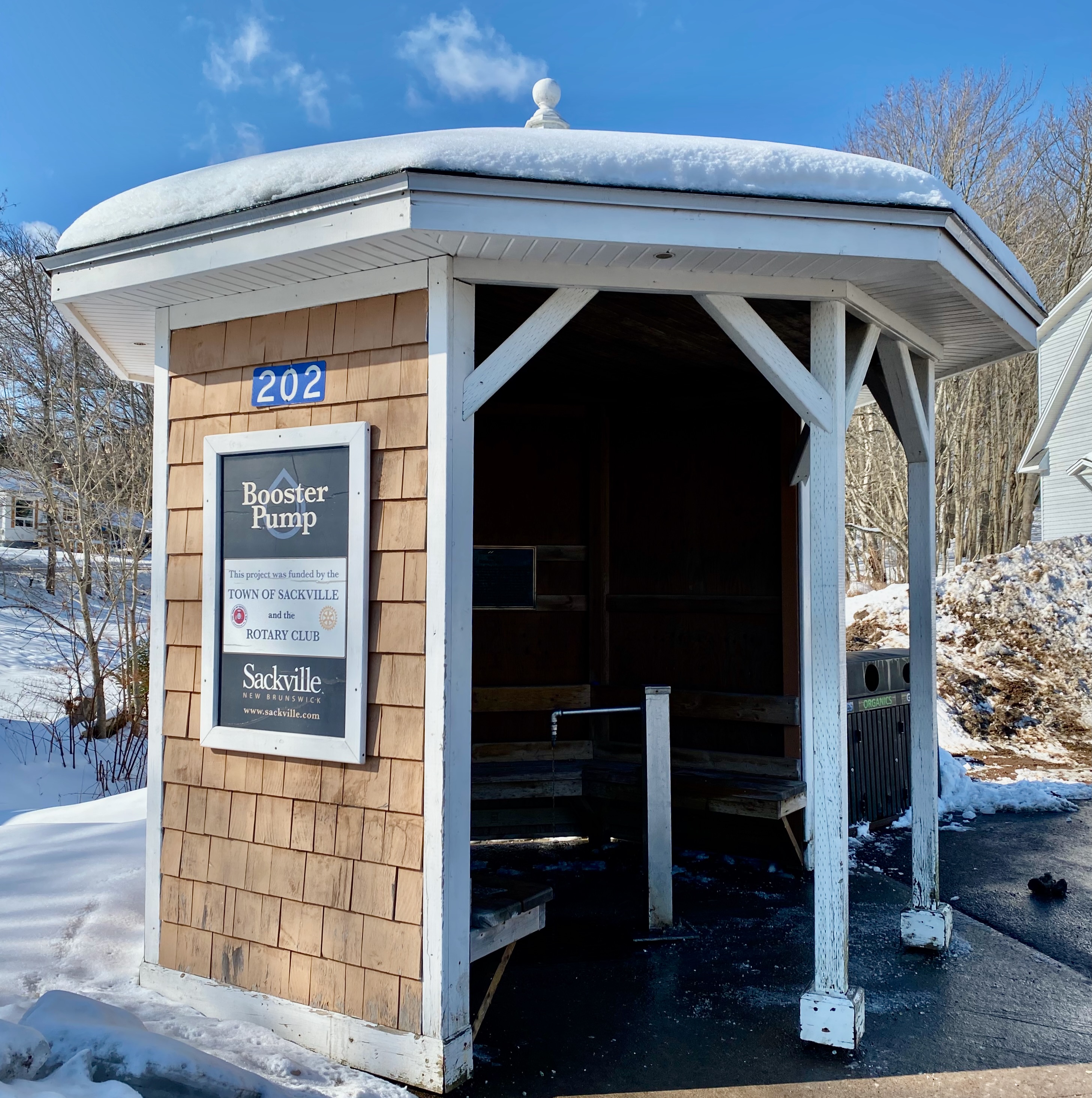
In 1987, the Rotary Club constructed a shelter around the “Booster Pump” on Main St. and in 2017, it collaborated with the town in re-building the shelter and paving the adjacent parking area

Other projects that Rotary helped fund include the wooden shelter around the “Booster Pump” on Sackville’s Main Street; the “Rotary Bridge” spanning a stream that flows out of the Swan Pond on the Mt. A. campus; the Observation Tower in the Sackville Waterfowl Park and a fountain in the atrium of the Sackville Memorial Hospital.

At the conclusion of Louise MacKinnon’s presentation on Tuesday, Councillors Goguen, Tower and Martin thanked the Rotary Club for its work with the last word going to Councillor Allison Butcher:

“I just wanted to say that in our role here as elected officials who help to make decisions and move forward with the community, to have you come and remind us what a fabulous number of volunteers we have here and how incredibly fortunate we are to share this place together, I’d just like to say thanks.”

To read Charles Scobie’s History of the Rotary Club of Sackville, click here.

For information about the Gold Mine 50/50 lottery draw, click here.

To read a story about another of Charles Scobie’s books, People of the Tantramar, click here.

Posted in Town of Sackville, Town of Tantramar | Tagged | 7 Comments