

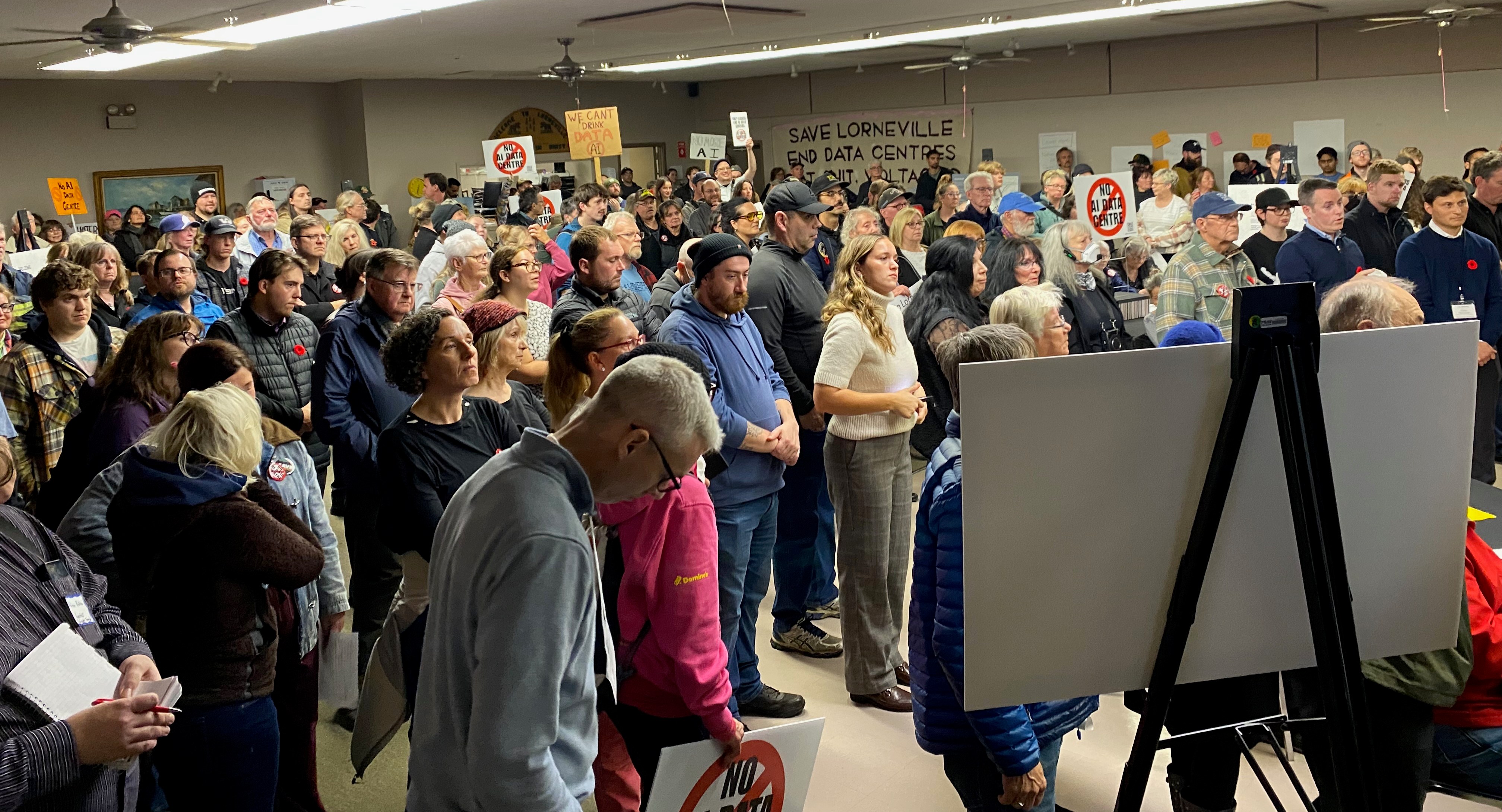
Activists fighting against a proposed hyperscale data centre in Lorneville, west of Saint John, successfully seized control of a company information session Thursday and turned it into a boisterous town hall.
They used it to air their complaints about the lack of information they say they’ve been getting from the U.S. firm VoltaGrid and its partner Beacon Data Centers of Calgary.

Ashley Anthony of the Save Lorneville group
“They do not want us to host a town hall, so we are going to host a town hall, with or without them, right?” said Ashley Anthony of the Save Lorneville group to a crowd of about 250 local residents and supporters who clapped, cheered and shook cow bells as company and government officials looked on.
The meeting, at the Lorneville Community Centre, had been advertised as an open house where local residents could talk with officials one-on-one and fill in comment sheets about the proposed project as a way for the companies to meet their obligation under the environmental impact assessment process to consult the local community.
“Beacon and VolaGrid don’t actually want to be here,” said Adam Wilkins, a main spokesman for Save Lorneville.
“They don’t give a shit about Lorneville or Saint John or New Brunswick,” he added to a burst of clapping and cheers.

Adam Wilkins of Save Lorneville
“Their white knight Nathan’s not even here tonight, so you can all rest assured that we won’t be getting any information from him,” Wilkins said to several shouts of “coward, coward,” from the crowd.
He was referring to Saint John native Nathan Ough. president and CEO of the Texas-based, energy company VoltaGrid.
Wilkins said Ough and Joseph Shovlin, executive vice-president of Beacon Data Centers are only interested in making money while New Brunswickers bear added financial costs as well as threats to their health and environment.
He pointed out that exactly one year ago on November 5, 2025, the pair held a Q&A with local residents.
“We didn’t get any answers to our questions sorted out and we didn’t have any information in the past year, so I don’t know what that says about offering real, meaningful community engagement and consultation. That’s what they say they want to do, but they don’t do that.”

Closed-loop cooling
“I have a question that I asked a year ago and I still haven’t gotten an answer,” said Lea Alexander. “How much water? We asked Nathan this a year ago and we got the answer of ‘zero.'”
She added that VoltaGrid talks about using a closed-loop cooling system, but won’t say much about how it would work, the chemicals they would use or what risks there might be, so her group conducted its own research.
“Closed-loop is a generic term,” she said.
“It tells very little about complete cooling, the heat reduction system, make-up water demand, wastewater generation or environmental risk,” she added.
“Closed-loop systems re-circulate the water, but the machines are working significantly harder and hotter. This uses more electricity and therefore, more water consumption and more emissions…These chemical systems need to be flushed. There is waste. There is discharge called blowdown.

Lea Alexander
“Waste management sites cannot handle this type of waste and cannot clean it. The proponents refuse to tell us how often it gets flushed, where does it go, and how does it get cleaned. They also won’t tell you what chemicals they utilize. They claim it’s proprietary information.”
“Bullshit,” a woman calls out from the audience.
Alexander went to to say there is one closed-loop system operating in Canada, at a smaller, 60 MW data centre in Cambridge, Ontario and that there are still unanswered questions about a leak that a resident discovered there.
“Can you answer how much water, yes or no?” Alexander asked company officials in the room.
“Can you tell us what forever chemicals you will use, yes or no? Where will the wastewater go?”
“If there are any water experts in the room that could help give us some answers, the community would appreciate if you could come up and tell us any details that you have,” said Ashley Anthony, who served a moderator of the impromptu town hall session.
“Why are these people here if they won’t answer questions?” a woman shouted from the audience to a burst of cheers and applause.
“They said they were coming here to answer questions,” a man shouted. “Why are they lying?”
‘Run them out of here’
“I live in Lorneville,” Wendy Maxwell told the crowd. “The place I live in, in Lorneville, has been in my family for three generations.”
She added that years ago, she worked with Nathan Ough at the local Sears.
“I remember him from the shoe department,” she said.
“We both understand, you can give us the best sales pitch, but if the shoe doesn’t fit, it doesn’t fit and this project does not fit Lorneville,” Maxwell said, adding that someone like Nathan who knows the community should understand why people are protecting their home.

Lorneville resident Wendy Maxwell
“I expect straight answers, not like the meeting we were to,” she said referring to the meeting on November 5, 2025.
“How much water? We don’t know. How much noise? We don’t know.”
Maxwell then talked about the risk of fire from the gas plant that will generate 190 MW to power the data centre.
She said her father is a retired Saint John firefighter and that the city does not have adequate firefighting staff and the risk is higher in Lorneville because the area has no hydrants.
Maxwell said that U.S. Democrat James Talarico won his Senate seat in Texas by campaigning to hold data centres accountable and giving communities the authority to decide whether they belong in their towns and villages.
“Do you really think this development belongs here in Lorneville?” she asked to a thunderous chorus of “Nos!”
“Are we prepared to fight?” she asked to a thunderous chorus of “Yeah!”
“Are we prepared to run them out of here?” she asked as people shouted “Yeah” accompanied by cheering and clapping.
“Everybody’s saying, ‘Elbows up, Canada, no U.S. companies. So what are they doing? Here comes the U.S. into Canada.”
“51st state,” someone shouted as the audiences booed.
“Why is our government backing down, premier, mayor etc?”Maxwell asked.
“Backing down to allow something that’s going to contaminate our wells, destroy our wetlands, tear down 400-year-old forests. You tell me why.”
“Money,” people shouted. “Greed,” someone said.
“People want a say over what happens where they live,” Maxwell said.
“This should hardly come as a surprise to anybody. So I have a straightforward question,” she added, addressing it to company officials.
“Will you respect this community’s right to reject your proposal?”
This is the first in a two-part series on Thursday’s town hall meeting in Lorneville.


Luddites of 2626.
What does this have to do with Sackville?