
 Two new critiques from the Protect the Chignecto Isthmus Coalition (PCIC) are challenging NB Power’s proposed 500 MW fossil fuel generating plant near Centre Village — but from very different angles.
In an academic paper, communications consultant Lisa J. Griffin argues the project reflects a long history of colonial dispossession that ignores Indigenous sovereignty while advancing industrial expansion with destructive cultural and environmental effects.
And, in a separate letter to PCIC supporters with copies to Premier Susan Holt and several of her ministers as well as NB Power CEO Lori Clark, Atlantic Wildlife Institute director Barry Rothfuss warns NB Power is using “scare tactics” about electricity shortages to promote what he calls a “fatal remedy” that would create environmental and health risks far greater than the problems it claims to solve.
‘Energy colonialism’
In her paper Energy Colonialism on the Chignecto Isthmus, Griffin examines how the history of the region has been told — and how those narratives shape present-day decisions about land and energy development.
Griffin argues that the Chignecto Isthmus, known to the Mi’kmaq as Siknikt, sits at the geographic and cultural centre of Mi’kma’ki, the traditional territory of the Mi’kmaq people. For centuries it served as a portage route and trading corridor linking the Bay of Fundy and the Northumberland Strait.

PCIC communications consultant Lisa Griffin
Yet she says mainstream histories have tended to frame the Isthmus primarily as a strategic frontier between European empires, highlighting French and British fortifications such as Fort Beauséjour while relegating Indigenous and Acadian communities to secondary roles.
According to Griffin, that historical framing continues to influence modern policy debates. She argues that energy infrastructure projects — including hydroelectric dams, nuclear generation and now the proposed gas plant — are often presented as inevitable steps in economic development while the underlying questions of Indigenous sovereignty and environmental justice remain largely excluded from the discussion.
Using the concept of “slow violence,” Griffin argues that environmental harm linked to fossil-fuel infrastructure often unfolds gradually across decades, making it less visible in short-term policy debates even as it shapes long-term climate and ecological outcomes.
‘Fatal remedy’
While Griffin approaches the issue through history and political theory, Rothfuss focuses on the potential environmental and health consequences of the proposed project.
In his letter, he argues NB Power is using warnings about possible electricity shortages to justify building a large fossil-fuel generating station in one of Atlantic Canada’s most environmentally sensitive regions.
Rothfuss describes the proposal as a “fatal remedy,” arguing the plant would create health and environmental risks that outweigh the reliability concerns it is supposed to solve.
He criticizes NB Power Vice President Brad Coady for warning that “people will die” if electricity shortages cause rolling blackouts.
“Deaths attributed to rolling blackouts in Canada are extremely rare,” he writes, adding that blackouts caused by storms, downed power lines and equipment failures happen all the time and in such cases, additional power plants aren’t any use.
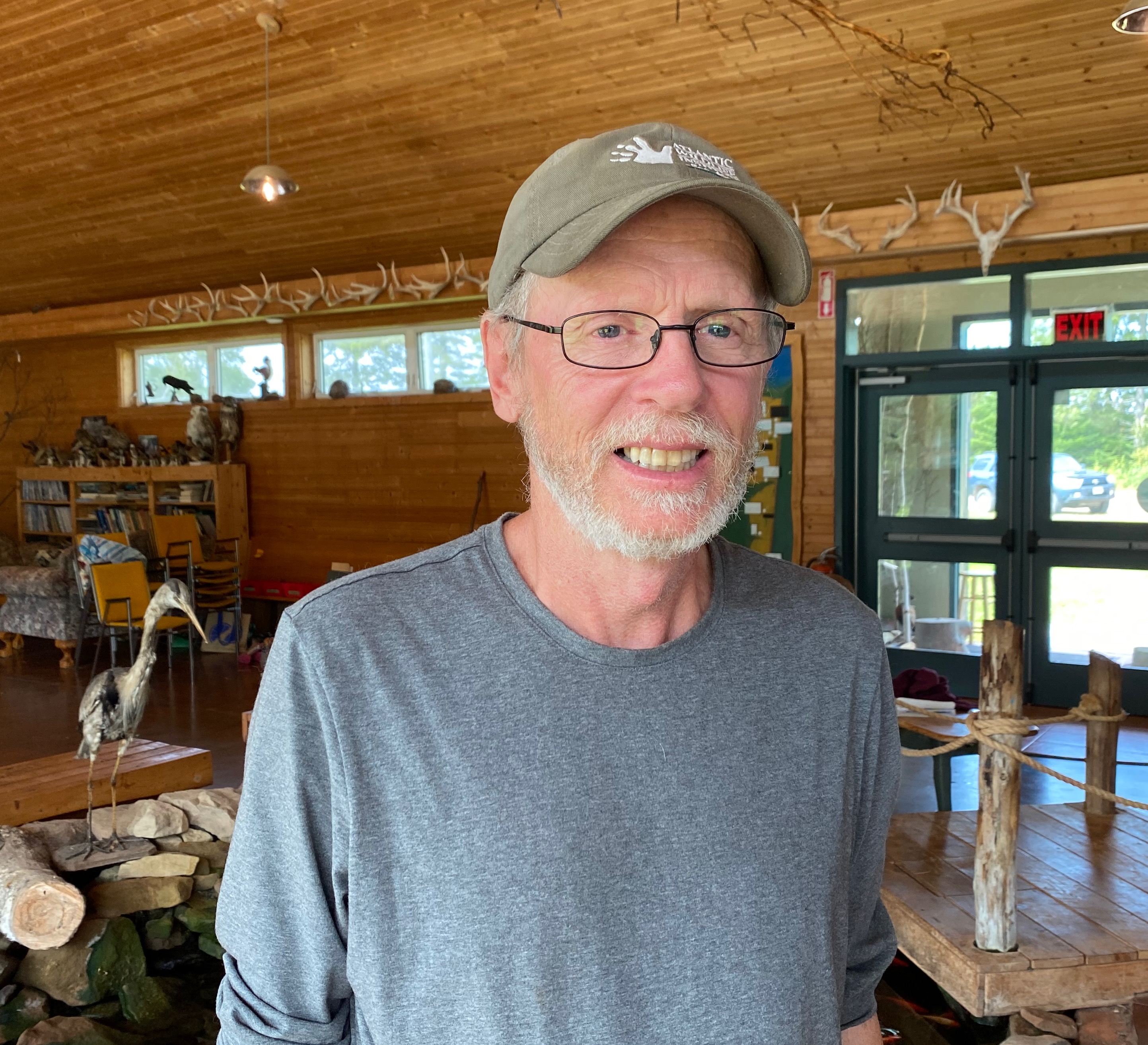
Barry Rothfuss, AWI executive director
Rothfuss also points to research on “peaker plants” — fossil-fuel generators that operate during periods of peak electricity demand — arguing they are associated with higher pollution levels and severe effects on people’s health in nearby communities.
Studies in the United States, he writes, have linked peaker plants to emissions of nitrogen oxides, fine particulate matter and other pollutants that contribute to respiratory illness, cardiovascular disease and higher rates of asthma.
His concerns also focus on the ecological importance of the Chignecto Isthmus wetlands and wildlife habitat as well as its significance as a critical corridor for migratory birds and other species.
Building a big gas plant there, he argues, would cause severe pollution in a rural landscape whose economy and identity are closely tied to wetlands, wildlife and tourism.
Taken together, the negative effects, he writes, far outweigh its supposed benefits.
To read Lisa J. Griffin’s paper, click here.
To read Barry Rothfuss’s letter, click here.


Griffin’s polemic presents a number of features that should be examined. I describe it as a polemic because it has clear biases, is written with a political agenda, and does not look like it was peer-reviewed or published in a journal, making it questionable to refer to it as an “academic paper”.
“This historiography examines the dominant narratives that naturalize fossil fuel expansion as inevitable ‘progress’ versus counter-narratives from Mi’kmaq communities, Acadian descendants, and contemporary environmental activists who expose how energy infrastructure perpetuates colonial dispossession. Through the lens of Nixon’s slow violence…”
Personally, I haven’t encountered anyone, even in NB Power, who portrays the proposed gas generator as “inevitable ‘progress'”. It has, at most, been presented as an interim measure that will replace energy that is currently generated by coal that causes far more environmental damage.
Contrasting this non-existent argument with “counter-narratives from Mi’kmaq communities, Acadian descendants…” immediately introduces Griffin’s prejudices: she’s presenting a segment of the population as more virtuous, more in tune with nature, because of their ancestry. Such ideas about race and ancestry based virtues were rightly left on the scrap heap by most people generations ago. They persist in the racism and identity politics of some academics and activists.
It’s probably true that there are better alternatives than the proposed gas generator. But by turning a discussion of the pros and cons of an electrical generator into “slow violence”, Griffin is refusing to address the real issues of how much power is needed, how it can best be provided, and how environmental damage can be minimized, instead using rhetoric, branding the other side as “violent” for opposing her, to delegitimize the other side instead of rationally addressing their propositions.
Her racial/cultural biases appear again in
“Fort Beauséjour, Fort Lawrence, Fort Gaspereaux—memorialize military fortifications while the Mi’kmaq and Acadian peoples who lived, traded, and resisted on this land are relegated to background roles in someone else’s war”
ignoring Fort Beauséjour’s museum exhibit “Revealing Chignecto: The Stories Within” that was according to Parks Canada “the result of an extensive collaboration between the Agency, the Mi’kmawey Debert Cultural Centre of the Confederacy of Mainland Mi’kmaq, in Nova Scotia, and Mi’gmawe’l Tplu’taqnn Inc. in New Brunswick” and setting the pattern for Griffin’s invention an idealized past where the Mi’kmaq and Acadians are peaceful, utopian peoples who “resist” oppression, while the British are evil. Her attraction to an invented, utopian, pre-industrial, non-technical past is visible in her description of the EUB:
“The EUB hearing process itself—with its technical language, legal formality, and presumption of expertise—privileges engineering assessments, economic modelling, and utility planning over community knowledge, lived experience, or Indigenous law”
which ignores what the EUB actually is, which is easily discovered on the EUB website:
“The New Brunswick Energy and Utilities Board regulates aspects of electricity and natural gas utilities as well as motor carriers, to ensure that customers receive safe and reliable service at just and reasonable rates. In addition, the Board sets weekly retail prices for petroleum products sold within the province.”
The EUB is not an open forum for unending testimony from people who think their “lived experience” is more important than how electricity actually works, even while those people insist on having a reliable, cheap source of electricity. The EUB is not a forum for all of the world’s problems and debates about centuries of history. If it became that, it would be useless.
Griffin correctly points out that sea level rise caused by fossil fuels is coming, and that the proposed gas plant will contribute to that damage. But the way she expresses this:
“…ensuring climate breakdown accelerates precisely when Mi’kmaq, Acadian, and Caucasian communities on this low-lying isthmus face catastrophic sea-level rise”
again demonstrates her racial prejudices, using the term “Caucasian” which comes from long-discredited racial theories generations ago, and far more bizarrely she makes a distinction between “Caucasian” (white) and Acadian, as though Acadians are not white because she wants to regard them as more virtuous than those she brands with the racist term “settlers”. Her racial and cultural biases appear again in
“The Tantramar Marshes—created through centuries of Acadian dyke-building”
where she misrepresents the timeline and nature of the marshes, ignoring the fact that the marshes are not an artificial creation, but existed as salt marshes for thousands of years before the Acadians modified them.
The area was colonized by the Acadians in the 1670s. The expulsion of the Acadians was 1755. The Acadians were in the area for less than a century, not the “centuries of Acadian dyke-building” in Griffin’s imaginary history. She consequently ignores the fact that for a much longer time, Yorkshire immigrants and their descendants maintained, expanded, and developed the dyke and drainage systems of the marshes. Ignoring them is another indication of Griffin’s racial and cultural prejudices. These appear again with
“But procedural fairness cannot overcome structural injustice when the process itself presumes Crown authority over unceded territory. Mi’kmaq Nations are relegated to ‘stakeholder’ status in decisions about their own homeland”
demonstrating that Griffin’s agenda is to present non-indigenous presence in Canada as illegitimate, present Canada’s government and laws as illegitimate, and that nothing except total indigenous control over everything is acceptable to her. This is fundamentally hostile to a vision of Canada based on equality and democracy, advocating instead a vision of Canada in which legitimacy is tied to race and ancestry.
She misrepresents debate as violence again with
“Canada’s constitutional framework recognizes Indigenous rights in Section 35 while simultaneously asserting Crown sovereignty—a contradiction resolved through violence”
instead of recognizing that a pluralistic, multicultural, democratic nation involves discussion, negotiation, and compromise, as well as requiring the rule of law.
Griffin continues her biases with a reference to “settler colonialism’s ongoing structure”, again demonizing some in society as illegitimate because of their race or culture. When Griffin states that
“Counter-narratives emphasize Mi’kmaq agency and resistance. When Governor Edward Cornwallis refused to recognize Mi’kmaq sovereignty in 1749, dismissing Peace and Friendship treaty obligation…”
Her own “counter-narrative” re-enforces her racial/cultural mythology of good Mi’kmaq and Acadians vs bad British, ignoring things like ( From: https://www.rcaanc-cirnac.gc.ca/eng/1360937048903/1544619681681 ):
“In an effort to regularise trade and assure a stable peace, British Governor Dummer sought out the region’s Aboriginal peoples and on December 15th, 1725, the two groups negotiated a “Peace and Friendship” treaty. The 1725 Treaty of Boston included the Aboriginal peoples of Maine, New Hampshire, New Brunswick, and Nova Scotia. Under the terms of the treaty, the Aboriginal signatories agreed to “forbear All Acts of Hostility, Injuries and discords towards all the Subjects of the Crown of Great Britain and not offer the least hurt, violence, or molestation of them or any of them in their persons or Estates.” With the treaty, Governor Dummer intended to prevent conflict between British settlers and local Aboriginal peoples by establishing trade relations with them and by acquiring their consent for British colonisation in the region.
The 1725 Treaty did not establish a long lasting and stable peace in the Atlantic region. French administrators at Louisbourg continued to offer presents to those Aboriginal peoples who agreed to attack British settlements. French missionaries also gave presents to those who opposed the British. The British and groups from the Mi’kmaq, the Maliseet, and the Passamaquoddy nations concluded peace and friendship treaties with each other on over half a dozen occasions between 1725 and 1779. Nonetheless, as the struggle for settlement lands continued throughout the continent, the French continued to turn to their Aboriginal allies for support. Hostilities in the region continued until Britain and France ended their conflict in North America at the end of the Seven Years’ War in 1760.”
Griffin’s polemic presents her views of history, race, and who she believes has a right to be listened to, but they don’t make a useful contribution to deciding what kind of electrical generation New Brunswick needs, where it should go, how the environment can be protected, and who should be heard. Instead, she presents a distorted history to support a vision of Canada in which race and ancestry confer special privileges, and where resentment and ancestral grievance is used to disenfranchise and delegitimize another group in society because of their racial or cultural status as, in her term, “settlers”.
Stereotyping and racism have no place in local wildlife protection. Lisa Griffin’s paper stereotypes First Nations as noble eco-guardians while casting “settlers” and Caucasians as colonial villains. It completely ignores the real benefits that First Nations partnerships on energy projects have delivered to many Indigenous communities across Canada. That’s not environmental advocacy, it’s divisive identity politics. The gas plant should be evaluated strictly on its merits and flaws: actual emissions data, grid reliability needs, real wetlands and wildlife impacts, and practical alternatives. Not on ancestral bloodlines or colonial guilt narratives. Keep radical narratives out of wildlife protection.
Excellent points you have raised, Allen. From working in the West, those First Nations who have allied with various O&G companies are certainly reaping the benefits, be it in terms of standard of living and employment, as an example. Being a veteran of many projects on the engineering side, I have never heard the likes of the contentions of the Griffin paper. If anything, she shows a deep misunderstanding on the reality of the issue.
This article appears to me to be a critical academic analysis of fossil fuel expansion in New Brunswick, focusing on how infrastructure projects impact Indigenous sovereignty and rural communities. The essay argues that proposed developments, such as a 500 MW natural gas plant, continue historical patterns of colonial dispossession by favoring corporate interests over treaty rights and environmental justice. No content in this text is deemed racist; it is a scholarly examination of structural power, institutional history, and environmental impacts in the region.
I believe “The kids” would call Griffin’s paper a “Try hard”.
As in she’s trying very hard to make an argument that doesn’t need to be made, and is erroneous in its presentation.
I do agree with both Jon and Allen, so much so there’s nothing more to add really. After reading her presentation… it read more of an almost insult (“The Noble Indian”) than something legitimate to maybe prop up the Mi’kmaq position about the area.
I think it did more harm that good overall; certainly it read like a first draft to something that *might* be maybe, possibly, a little bit of a serious piece, but with no pushback from an outside source to clarify her position.
I agree, Elaine. More harm than good is exactly what I got out of that article. It’s not something the EUB would even consider. They evaluate projects on their overall flaws and merits, not this type of racialised stereotyping.
Bravo, Jon. No rebuttal from the naysayers, yet. Well done.
Re: “Two new critiques challenge NB Power’s proposed Isthmus gas plant” (April 8, 2026)
Lisa Griffin’s paper Energy Colonialism on the Chignecto Isthmus, as summarized in Bruce Wark’s article, offers a thoughtful historical lens on the Chignecto Isthmus (Siknikt) and raises valid points about Mi’kmaq sovereignty, unceded territory, and the concept of “slow violence” from long-term infrastructure decisions. Treating Indigenous nations as mere “stakeholders” rather than rights-holders in regulatory processes is a fair critique in many Canadian energy debates.However, the analysis falls short by presenting the proposed 500 MW natural gas peaker plant as a straightforward continuation of colonial dispossession, without acknowledging the real and growing reality of Mi’kmaq agency and economic participation in New Brunswick’s energy sector, including transitional fossil fuel and reliability projects.
Across Canada, First Nations have increasingly secured ownership stakes in large-scale fossil fuel infrastructure, not as passive recipients of benefit agreements, but as active equity partners. Examples include the Haisla Nation’s majority 50.1% ownership of the Cedar LNG project in British Columbia, Indigenous consortia acquiring significant shares in major pipelines like Enbridge’s oilsands lines and Westcoast Transmission, and other LNG and midstream assets. These arrangements deliver revenue, jobs, contracting opportunities, and greater self-determination for communities.In New Brunswick specifically, NB Power has partnered with Mi’kmaq First Nations on wind energy projects, and documents show the North Shore Mi’kmaq Tribal Council expressed strong interest in an equity stake in the Isthmus gas plant proposal (with options explored for up to 33% in related entities). While no final deal has been exercised, some communities and leaders have viewed potential investment as a pragmatic path to economic benefits, subject to their own rights impact assessments and community consent processes. Mi’kmaq perspectives are not monolithic, there is documented division, with calls for deeper consultation alongside interest in participation.
By framing the project solely through a historical colonialism narrative and ignoring these contemporary dynamics of Indigenous economic reconciliation, Griffin’s critique risks flattening diverse Mi’kmaq voices into a single story of victimhood and resistance. It overlooks how many Indigenous groups see ownership in reliable energy infrastructure (including gas peakers that can backstop renewables and replace older, dirtier assets) as a tool for empowerment rather than pure imposition. Meaningful reconciliation requires grappling with both sovereignty concerns and pragmatic choices.
In the end, Griffin’s approach reveals a deeper bias: it consistently casts First Nations as perpetual victims of “energy colonialism” while erasing their role as capable participants and decision-makers who pursue equity stakes for their own communities’ benefit. This paternalistic lens does a disservice to the very peoples it claims to champion, reducing complex Indigenous agency to a convenient narrative of ongoing dispossession.Readers and policymakers deserve the full picture including how Indigenous communities are asserting agency through ownership, not just opposition.
Allen, why are you such a “try hard” against the protection of our wildlife and wetlands?
It has nothing to do with wetland or wildlife protection, that’s why it’s so ridiculous. It’s certainly nothing the EUB or the provincial regulators would take seriously. I’m not the only one who’s criticized it, if you haven’t noticed. It’s not getting great reviews. I think the AWI could find a better communications expert. This Griffin lady is a poor communicator who is very biased, she failed to recognize the energy projects that First Nations are actually partners in and working on to better their communities and lift them out of poverty. At least Barry’s letter makes more sense because it talks about his actual concerns.
Many long-established families in the Sackville and Tantramar region trace their roots directly to the Yorkshire settlers who arrived between 1772 and 1775. These hardworking immigrants from northern England, families such as Dixon, Bowser, Atkinson, Anderson, Bulmer, Harper, Patterson, Fawcett, Richardson, Humphrey, and Wry, purchased land (often from departing New England Planters), drained and dyked the marshes for productive agriculture, built early Methodist churches, and remained loyal to the British Crown during turbulent times.
Their descendants still live and farm in the area today, viewing this heritage as a story of resilience, self-reliance, and community-building rather than oppression. When opposition to the proposed Isthmus gas plant frames the entire history of European settlement on the Chignecto Isthmus as “energy colonialism” and ongoing dispossession, it risks deeply alienating many families. Many feel their ancestors’ contributions are being stereotyped or diminished through modern academic grievance narratives.
As a result, potential local donors who might otherwise support the Atlantic Wildlife Institute’s valuable wildlife rehabilitation and marsh conservation work could decide to redirect their giving elsewhere, viewing the organization’s associated advocacy as more ideological than practical. This narrow historical lens can shrink community support and make broad-based funding for genuine environmental efforts harder to sustain in a region proud of its Yorkshire roots.
Excellent insights, Susan. Thanks very much for sharing them.
Whether it’s through “academic grievance” or “catastrophic environmental/climatological” narratives, the anti gas facility folks dont seem to comprehend that they do not speak for the majority of us. The noise they continue to make tends to be louder than any position that supports the plant, which is unfortunate. It brings to mind a saying my father had, that being “empty barrels make the most noise.” I have seen firsthand, the condescension they carry for any person or organization who stands in favor of it. Personally, I approve of the decision by the project proponents, in regards to the type and purpose of the plant, versus the alternative.
In terms of “local potential donors ” of the refuge you allude to, my family were long time supporters of it, yet recently decided to help out elsewhere, solely as a result of their continuing crusade against the facility. Through all this anti-gas rhetoric, it seems to be forgotten by all that are against it, that there are thousands of hydrocarbon facilities currently in operation in North America (as an example), in ecosystems as sensitive (if not more) than that which exists in Centre Village. Noise abatement and airborne emission protocols are in place, that would be utilized here. Hydrocarbon gas vent limits, be it in the form of particulate, methane, nitrogen oxide or volatile organic compounds are under strict controls. Groundwater typically is not touched, rather, deeper wells with consistent water supply are used instead. On a different note, It is my understanding that the refuge has allied itself with the same group who were behind the anti-fracking clashes near Rexton, a few years back. Do we then assume that their objectives will be forced through the use of violence? I sure hope not. We don’t need that level of public disorder in our community.
I really like how both pieces reviewed here take very different angles to critique NB Power’s absurd Tantramar gas plant project. Barry Rothfus synthesizes very well the health and biodiversity threats posed by the plant; Lisa griffin brings a new perspective connecting the project to ongoing colonization of the Mi’kmaq land that is very refreshing.
She is spot on, colonization is completely invisible in the debates around the plant, and any other issue in the province as well. I haven’t seen anything more than some symbolic gestures around reconciliation but when it comes to pushing polluting and outdated projects, we’re very good at that it seems. But even mentioning colonization seems to ruffle some feathers – proving the author’s point…
Good thing the economics for that plant don’t work out and that batteries + renewables are much cheaper. I’m a bit puzzled though why the government keeps repeating NB Power/ ProEnergy’s talking points instead of doing the calculations…
In any case, whether we like it or not, we’re on Mi’kmaq land, and it is the Mi’kmaq who will decide if that project moves forward or not.
For readers’ information, the long comments/replies by Allen, Allen Crane, Susan, and Charles Langlois all are very likely to be AI-generated according to detectors (98-100%) – whatever that means.
AI slop is increasingly common on blogs, see articles below. It could also be an effective and cheap way to mobilize public opinion in favour of a controversial project. Better not to engage.
https://www.bbc.com/news/articles/c9wx2dz2v44o
https://medium.com/@diana.c10/ai-generated-comments-the-newest-form-of-spam-d98026985b59