Amherst mayor talks about flooding, climate change and youth at Sackville forum

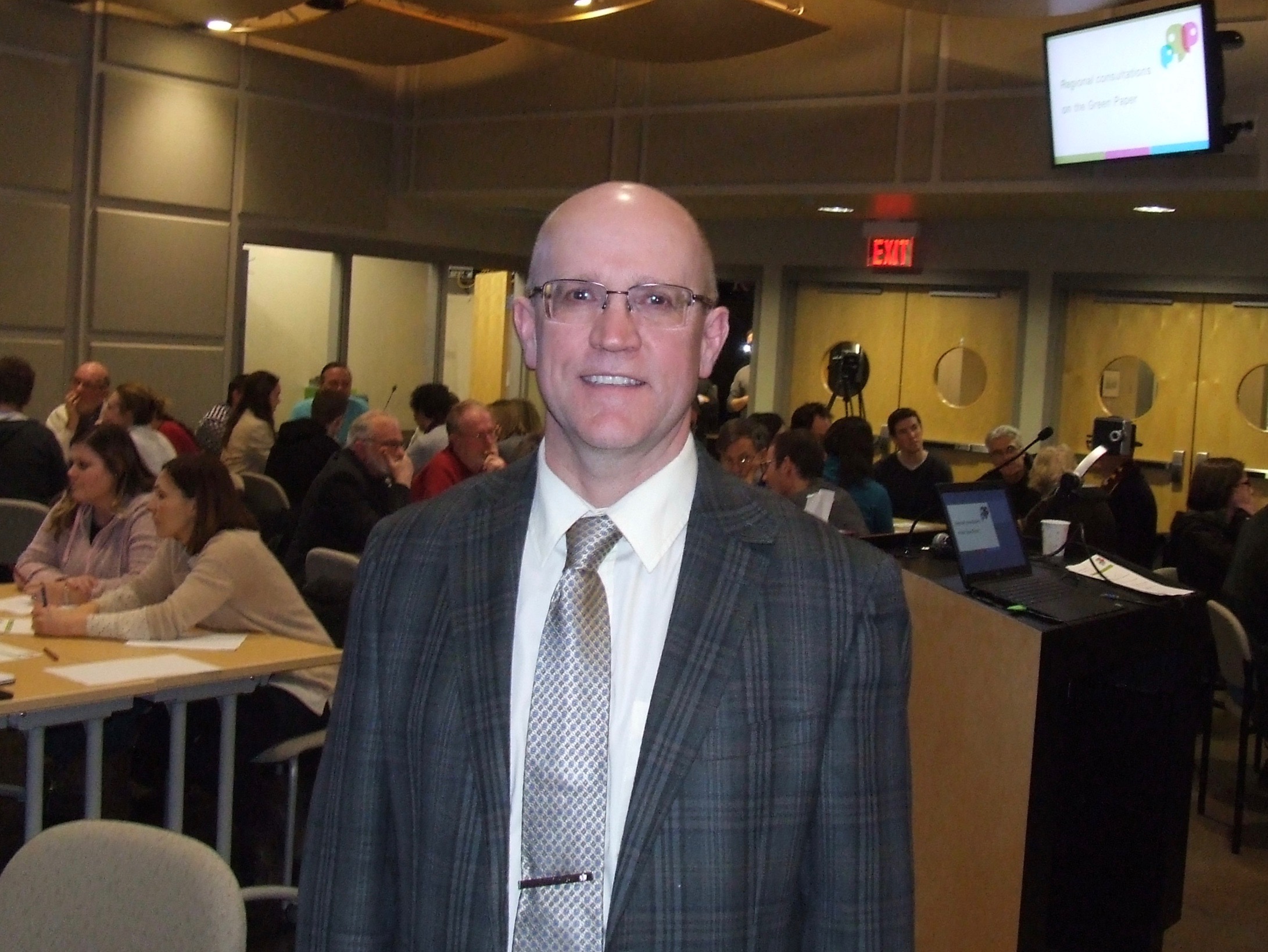
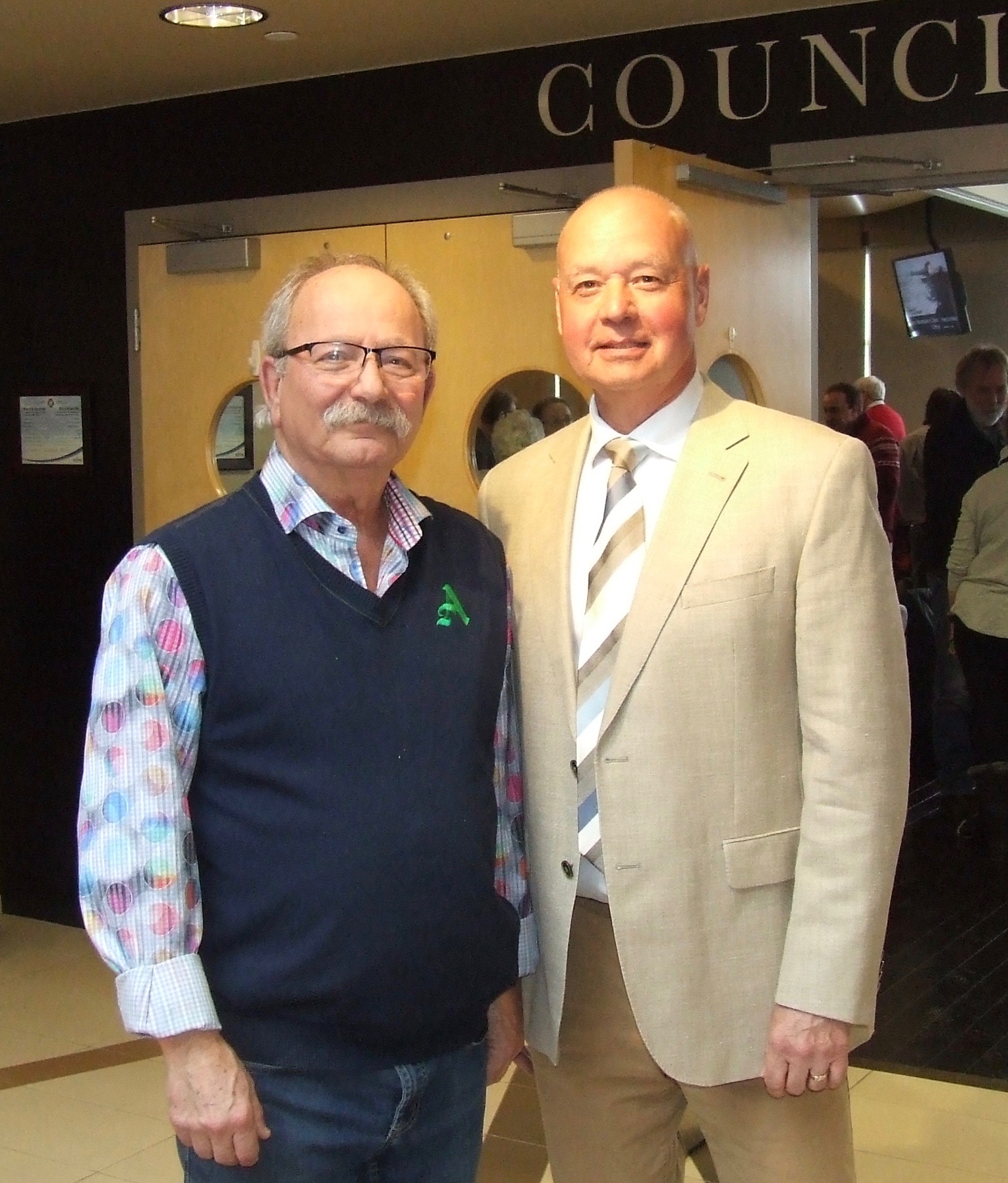
Amherst Mayor David Kogon (L) and Sackville Mayor John Higham at Saturday’s climate change forum

Amherst Mayor David Kogon says one of the options for protecting the transportation corridor on the Chignecto Isthmus could be to elevate both the TransCanada highway and the CN Rail line to prevent flood waters from cutting the commercial links that carry traffic worth $50 million every day between New Brunswick and Nova Scotia.

During a presentation last Saturday to the Mayor’s Roundtable on Climate Change in Sackville, Kogon said he warned a senior official in Nova Scotia, however, that protecting commercial traffic wouldn’t be enough because large parts of the towns of Amherst and Sackville are also at risk.

“[I] said if that’s the option that gets picked [protecting commercial traffic], you’re going to have a really hard time from the towns because we’re not going to sacrifice the land and let Nova Scotia become an island,” Kogon told an eight-member climate change panel at Sackville Town Hall.

“I got very significant assurances that that would not be a viable option, that we do have to save the land [and the towns] and not just the commercial corridor,” Kogon said.

He pointed out that he and Sackville Mayor John Higham had pressed the federal and provincial governments to undertake the latest $700,000, year-long study of ways to prevent flooding caused by rising sea levels and severe storms related to climate change.

“We’re very pleased to be able to say that now that that study will start,” he added, “I feel great pride that at the municipal level, we were able to initiate significant action at the provincial and federal level.”

New energy manager

“Amherst is very keen on being green,” the Amherst mayor told the climate change panel as he outlined a number of steps his town is taking including hiring an on-site energy manager to provide expertise in using energy more efficiently.

“This is an investment of about $100,000 a year for two years,” Kogon said, “and when this was announced, we got some negative feedback through social media from our citizens [because] a hundred thousand dollar expense to a community our size is pretty significant.”

Kogon added, however, that Amherst consumes about $860,000 worth of non-renewable energy every year.

He said that Cape Breton Regional Municipality reduced its spending on energy by 25% after hiring an on-site energy manager.

“We know that if we can even garner half of that, it’s going to more than cover the cost of this manager,” he said. “So, not only will it make us more energy efficient and reduce our carbon footprint, we expect it will cost almost nothing or maybe even save us money.”

Amherst Youth Town Council

November photo from Amherst Youth Town Council Facebook page

Mayor Kogon mentioned that for many years, Amherst has been taking advice from its Youth Town Council (YTC), a small group of students from Grades 7 to 12 who apply for the position and are appointed by the elected councillors.

He said the Amherst YTC meets almost every month and presents its reports at every town council meeting.

“At their urging, we declared a climate emergency,” he said, a step that Sackville Town Council refused to take last April.

Kogon said he’s been invited to the next YTC meeting on February 10th to give a report on Amherst’s various climate change initiatives.

“They’re great advocates and proponents, so we really like working with them and it’s a great communication channel for the youth.”

When panel member Quinn MacAskill asked whether climate change is a top priority for the YTC, Kogon said it is one of their absolute top priorities.

“They gave us a very real understanding of how threatening this is to them and they fear for their future,” he said.

“They didn’t mind insulting me in saying, ‘Well, you’re pretty old, it’s not going to matter to you, you’ll be gone’ and they’re probably right,” he said as members of the panel laughed along with about 65 people who attended Saturday’s climate change forum.

Posted in Amherst, Environment, Town of Sackville | Tagged , , | 1 Comment

Sackville town councillors respond to RCMP complaint about public police briefings

Councillor Bill Evans

After six months of holding RCMP briefings in public, two Sackville town councillors have signalled it may be time to start hearing from the police again behind closed doors.

During last night’s town council meeting, Councillor Bill Evans suggested that while it’s important to conduct as much town business as possible in public, he’s troubled by the lack of candour at the monthly RCMP briefings.

“It’s important that…anything we can do in public, we do in public, and so that kind of transparency is good, but also the more candid back and forth,” he said, suggesting that private, in-camera meetings would allow the RCMP to provide details they can’t make public while giving councillors a chance to discuss issues that concern them.

Evans wondered if there weren’t a way that council could hold private and public sessions with the police.

He was responding to RCMP Sgt. Paul Gagné who ended his monthly report last night by complaining that the open sessions aren’t as productive as the ones behind closed doors.

“Since we changed the format of our present meeting to being open to the public, I personally don’t find as much value in being here as I did before because I found our exchanges much more, I would say, hearty and substantial,” Gagné told council.

Councillor Michael Tower

When Councillor Michael Tower said that maybe one in every four of the RCMP briefings could be held in private, Gagné suggested four public sessions a year with the rest behind closed doors.

Town Council moved to public RCMP briefings in September partly in response to a series of reports in the Irving-owned newspapers detailing the frequency of closed municipal council meetings in the province.

Warktimes also raised concerns about the lack of public briefings from the RCMP during a council meeting in August when I pointed out that policing accounts for a large chunk of the town budget.

This year, for example, Sackville plans to spend nearly $1.9 million for police services, the largest, single expenditure in its $11.4 million operating budget.

So far, the public RCMP briefings have been fairly routine, except for a session in October when Councillor Tower pressed the police to do more to protect Sackville’s water supply –an issue the public wouldn’t have learned about under the old system of in-camera, police briefings.

Tower pointed out at the time that he had raised the issue of oil tanker trucks parking near the water supply repeatedly during closed-door sessions with the RCMP.

To read coverage of that meeting including the RCMP response to Tower’s concerns, click here.

Posted in Town of Sackville | Tagged , , | Leave a comment

Classes cancelled as Mount Allison professors and librarians walk off the job

Mt. A. professors and librarians picket at campus entrances on first day of their latest strike

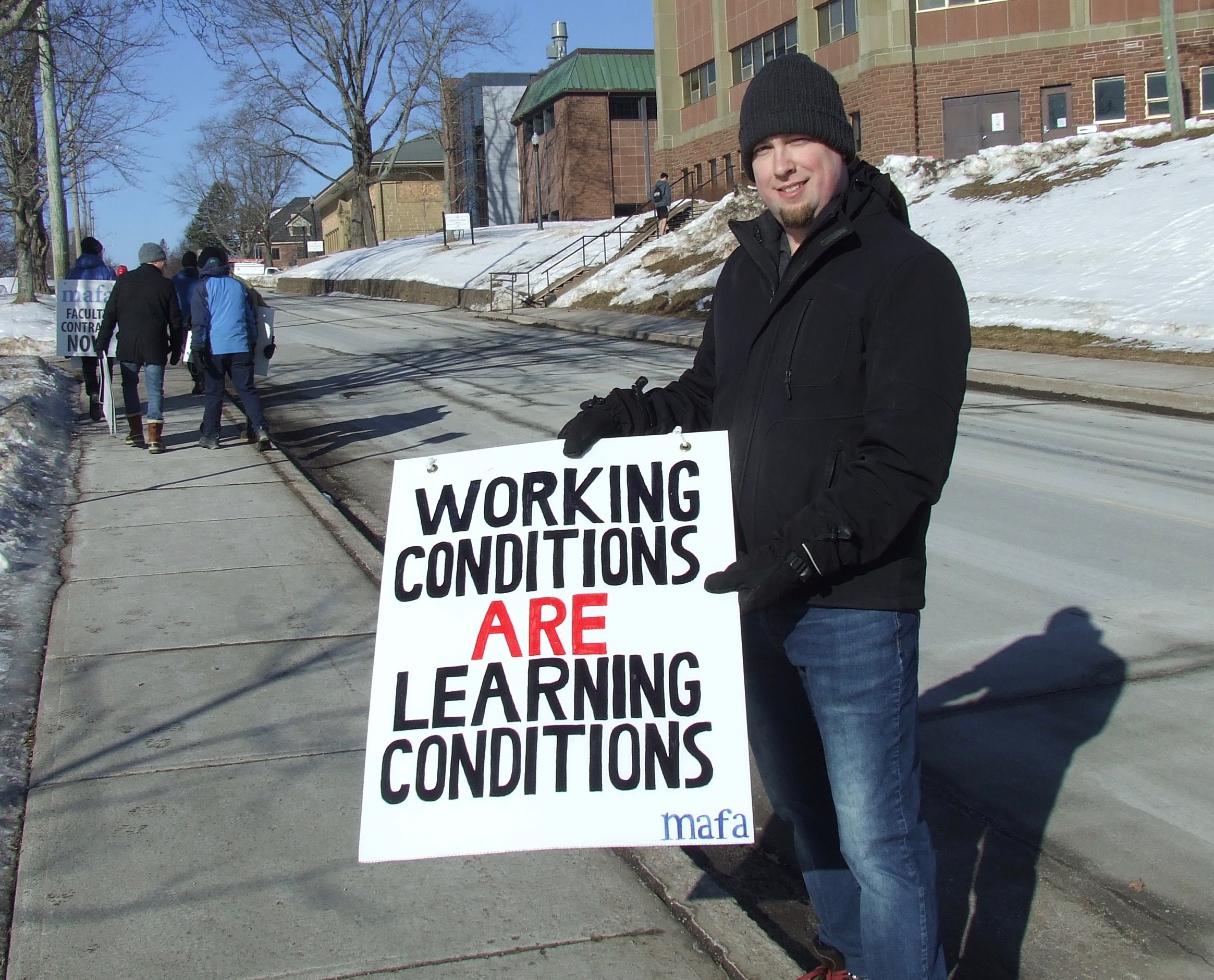
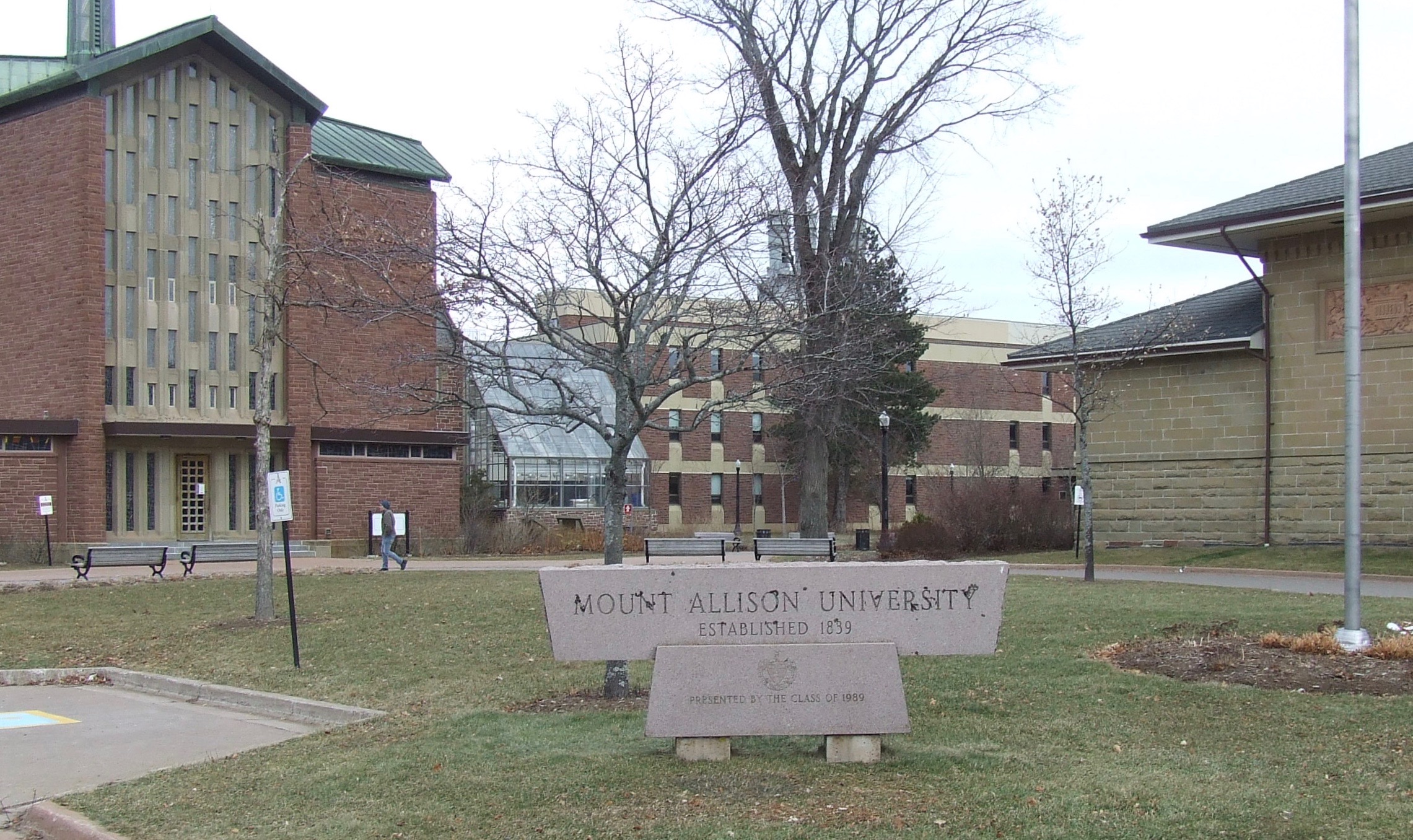
Classes have been cancelled for about 2,200 students at Mount Allison University in Sackville where more than 200 full and part-time professors and librarians have walked off the job — their second strike in six years.

“We’re very upset,” Matthew Litvak, president of the Mount Allison Faculty Association (MAFA), said this morning during an interview on CBC Radio.

“If you look at the history of the negotiation process at Mount Allison University, it’s not been very positive,” he added. “There doesn’t seem to be a recognition of what we need to do and what resources need to be provided to deliver the programs that the students depend upon.”

Among other things, MAFA is seeking better pay and improved job security for its part-time members as well as replacement of faculty and librarians who retire or are away on leaves for maternity, illness or sabbaticals.

MAFA maintains that over the past decade there has been a drop in the number of full-time faculty of about 7% and an increase in the number of part-timers, while the number of librarians has fallen by a third over 15 years.

Final offer

Litvak accuses the administration of presenting a “take-it-or-leave-it” final offer as both sides bargained over the weekend with the help of a provincially appointed mediator.

“We were informed by the mediator that the employer would consider only minor tweaks to their take-it-or-leave-it offer,” he says. “It’s unfortunately clear from their actions that they may be willing to meet, but they’re not willing to meet to negotiate a settlement.”

For the latest news release from MAFA, click here.

Meantime, Robert Hiscock, a spokesman for the university administration, told CBC listeners that its bargaining team put forward an offer on Saturday that it hoped would provide the basis for a settlement, but MAFA rejected it.

“We tried to put the best offer on the table addressing as many issues as we could and some of our own issues and it just didn’t work out,” Hiscock said.

In an online posting, the administration describes the contract changes in its latest offer as “financially sustainable, while continuing to support the academic mission of the University.”

To read the details, click here.

Striker holds placard summarizing union’s position

Students’ Union remains neutral

The President of the Mount Allison Students’ Union (MASU) says the strike is creating uncertainty and stress for students caught in the middle.

During a telephone interview, Emelyana Titarenko adds that MASU will push for tuition rebates based on the length of the strike.

“The fact that we won’t be having any seminars, lectures or labs, tutorials or any access to librarians is a pretty big cost when it comes down to it because we are paying for these services,” she says, noting that the administration does say on the university website that “any adjustment to tuition will be based on the length and impact of the strike.”

Titarenko, who hopes to graduate this year with a Bachelor of Science degree, says MASU is remaining neutral in the labour dispute.

“Although we do have a neutral stance on the matter,” she adds, “it doesn’t mean that we’re going to be inactive. We’re doing everything we possibly can to make sure that MAFA and the administration find a solution as quickly as possible.”

To read MASU’s news release on the strike, click here.

Posted in Mount Allison University | 1 Comment

Another flood study? Just work on solutions, says Mt. A. professor

Dr. Jeff Ollerhead

A scientist who teaches at Mount Allison University is wondering why the federal and provincial governments are commissioning a year-long, $700,000 study to find ways of preventing flooding on the Chignecto Isthmus, the 20 kilometre strip of land that connects New Brunswick and Nova Scotia.

“It’s not clear to me why we need to spend this kind of money on doing another study,” says Jeff Ollerhead, a professor in the Mt. A. Geography and Environment Department.

He points out that a number of studies have already been done.

“It doesn’t take new science to know that there’s a problem,” Ollerhead says, “therefore, at what point are we actually going to start to plan the solutions?”

He was commenting on this week’s announcement that the New Brunswick government has chosen Wood Environment & Infrastructure Solutions to complete the study by mid-February 2021.

The international engineering company has been asked to come up with “three viable solutions” to protect key infrastructure that runs across the Tantramar Marshes including the TransCanada Highway, the CN rail line, electrical transmission towers and communications facilities such as fibre-op cable links.

Ollerhead says the study might be worthwhile if it quantifies the strengths and weaknesses of the dyke and aboiteaux systems that hold flood waters back.

“[But] my bias would have been towards spending more of the money on actually starting to work on solutions as opposed to studying the problem,” Ollerhead says.

“This study is all fine and dandy, but eventually you have to do something with the results and I haven’t heard any commitment that anybody will actually do anything with the results.”

MLA concerned too

Green MLA Megan Mitton

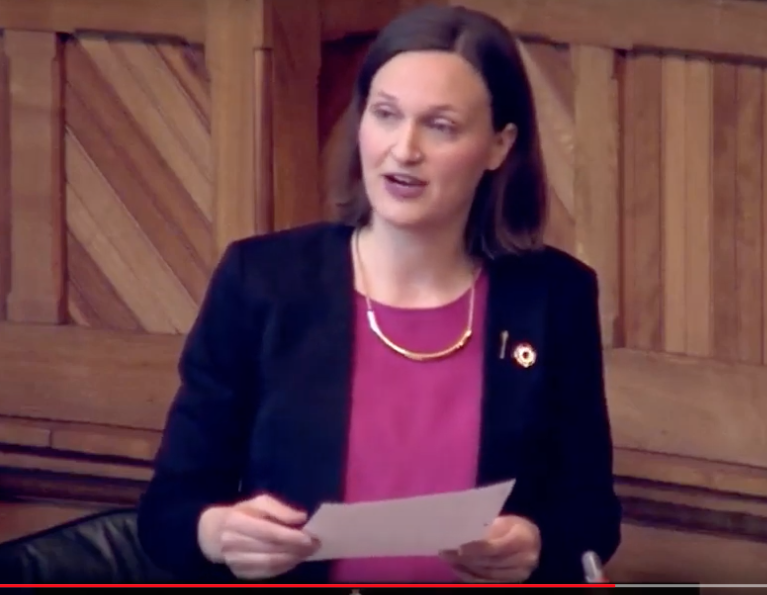
Green MLA Megan Mitton, who represents Memramcook-Tantramar in the New Brunswick legislature, says she’s worried too about another full year of study before anything is done to protect the transportation corridor as well as people’s homes and businesses in towns like Sackville.

“The federal and provincial governments have been moving much too slowly on this issue,” she says.

“I’m glad that action is being taken, but I’m worried that it’s going to be too little, too late because every year there’s a chance that the dykes will be overtopped.”

4 R’s as solutions

Meantime, Jeff Ollerhead notes that in coming up with possible solutions, the company conducting the study will have to choose among three options that scientists refer to as the 4 R’s.

“So, the four R’s are: option number one, raise and reinforce, essentially raise dykes, reinforce them, put in bigger aboiteaux, if you want to put it this way, harden the shoreline to a greater degree,” he says.

“Option number two is retreat. You’ve got a set of dykes, you move them back say, 300 metres which would typically move them a little further up the slope of the land,” he says.

“Option number three is relocate, so rather than trying to deal with the coastal defences, you take whatever the thing is that you’re protecting and you relocate it somewhere else.”

Ollerhead says the company conducting the study will likely recommend some combination of options one and two rather than recommend moving infrastructure like the highway or rail line away from the marshes to higher ground.

However, he says, there are other things to consider.

“In a hypothetical world, if you said, ‘well, gee we’re going to replace the aging, inefficient track with high-speed, electrified rail anyway,’ then maybe it doesn’t matter, maybe your plan is you put in new tracks somewhere else and eventually, you just let the other track go,” he says.

Ollerhead warns that something should have been done years ago because sea levels are constantly rising as shorelines subside and the situation gets worse every year.

He says it would be catastrophic if another storm such as the Saxby Gale of 1869 were to hit the Bay of Fundy.

“If that storm were to occur today, especially given that was 150 years ago and the land has subsided and the sea level has risen since then, if that same storm were to occur today, I expect the existing infrastructure would be pummelled probably into an unusable state,” Ollerhead concludes.

NB releases more details of study

The brief news release announcing the contract award for the $700,000 study gave few details.

But on Friday, the New Brunswick government sent Warktimes a copy of the original, 37-page document outlining the terms and conditions any company conducting the study must meet.

Here is an excerpt describing the “strategic importance” of protecting the Chignecto Isthmus transportation corridor:

The strategic importance of this infrastructure to all Atlantic Canada and indeed to the nation as a whole cannot be over stated. As an integral component of the Atlantic Canada Gateway and Trade Corridor (a federal/provincial designated system of major ports, marine terminals, international airports, key border crossings, and road and rail connections) it is the principal routing for all land based trade and passenger travel between Nova Scotia and New Brunswick and points west. The high voltage transmission lines are the primary connection to share and balance electrical generation between New Brunswick and Nova Scotia. Loss of the electrical transmission connection could produce significant economic and social impacts. As well, electrical exports from the Muskrat Falls hydro-electric facility in Labrador will be carried on these lines when they commence operations in 2019/20.

The transportation linkages are also critical to the Provinces of Prince Edward Island and Newfoundland and Labrador. In Prince Edward Island’s case, the TCH through the Chignecto Isthmus is the principal year-round route for trade and passenger travel to Nova Scotia. Similarly, for the Province of Newfoundland and Labrador all land based freight traffic must cross the Chignecto Isthmus for access to the Marine Atlantic ferry service or to the Oceanex direct water service from the Port of Halifax to St. John’s.

Previous studies have estimated the value of trade passing through the Chignecto Corridor at $50 million per day. Traffic counts at the NBDTI permanent counter near Aulac indicate annual average daily traffic (AADT) of 15,500 vehicles in 2016 with annual average daily truck traffic (AADTT) of 2,490 vehicles. There is also significant rail car traffic between NS and NB.

A combination of climatological induced sea level rise (1 to 5 metres) and coastal subsidence is forecast to threaten most coastal infrastructure in Atlantic Canada before the year 2100. The Chignecto Isthmus dykes and the infrastructure they protect are also at risk.

To read a longer excerpt that includes information about previous studies, click here.

Note: This latest study will be cost-shared with the federal government contributing $350,000 while the New Brunswick and Nova Scotia governments will provide $175,000 each.

Posted in Mount Allison University, New Brunswick government, Nova Scotia Government | 2 Comments

Mount Allison University heading for second faculty strike in six years

Barring a last-minute breakthrough, it appears that about 150 full-time professors and librarians at Mount Allison University will walk off the job next week, their second strike in six years.

The Mount Allison Faculty Association (MAFA) has set a strike deadline for Monday, February 3rd unless a new contract is negotiated before then.

MAFA says that in a vote earlier this month, 74% of full-time faculty who cast ballots authorized a strike if one is needed to press their demands on key issues such as staffing and workload.

However, the strike deadline does not apply at the moment to about 50 part-time professors after the university questioned the results of their strike vote.

MAFA announced last week that 94% of part-time members who voted supported a strike.

But the university says that since only 17 of 50 part-timers voted, it has asked the New Brunswick Labour and Employment Board for an opinion on whether that result reached the minimum standard for a strike mandate.

In a news release issued yesterday, MAFA announced it would hold another strike vote for part-time professors in an effort to resolve the issue and avoid a costly legal battle.

The release quotes MAFA President Matthew Litvak as saying that many part-time members are struggling to earn a living wage and that pay and job security for them have been crucial issues in the bargaining that began last June.

The province appointed a conciliation officer in August, but those talks ended in November with no agreement. Since December, both sides have been negotiating with the help of a provincially appointed mediator.

Two more rounds of mediation are scheduled for tomorrow and Friday.

Key issues

MAFA says both sides signed a protocol agreeing not to negotiate in public, but the university has released its latest, comprehensive offer along with information on such bargaining issues as faculty workload and salary scales.

(1) (a) MAFA wants the administration to restore what it sees as the number or complement of faculty needed to maintain Mount Allison’s status as the country’s leading undergraduate university. It says that over the past decade there has been a drop in the number of full-time faculty of about 7% and an increase in the number of part-timers, while the number of librarians has fallen 33% over 15 years. MAFA also says that the university is not replacing enough faculty who resign, retire or are granted maternity, sickness or sabbatical leaves.

(1) (b) The university rejects the claim that there aren’t enough faculty members to maintain courses and programs. While it says the numbers of faculty ebb and flow to match fluctuations in student enrolment, Mount Allison has maintained one of the lowest student-to-faculty ratios of any university in Canada. It also says that the use of part-time faculty is far lower at Mt. A. than at most other Canadian universities and that in the last three years, part-timers have taught an average of only 12% of the total number of courses.

(2) (a) MAFA wants higher pay and better job security for part-time faculty members on short-term contracts. It says these “precarious” workers earned an average of just over $12,000 last year, a figure well below the poverty line. MAFA acknowledges that the stipend part-time professors are paid at Mt. A. compares favourably with the rates at other universities in Atlantic Canada, but argues it’s still far from a living wage.

(2) (b) The administration says all universities use part-time faculty and that the $6,858 part-timers receive for each of the courses they teach is the highest among eight other comparable universities in Atlantic Canada. It adds that many part-timers are retired faculty members or professionals who are employed full-time outside the university and who supplement their other work by teaching.

Figures released in October show that 2,247 students were enrolled at Mount Allison this year.

A three-week faculty strike at Mt. A. in January/February 2014 ended when both sides agreed to binding arbitration after meeting with a special mediator appointed by the province.

Posted in Mount Allison University | Tagged | Leave a comment

Sackville forum discusses need to help students with disabilities


Participants at last Thursday’s forum on the future of public education seemed to agree that New Brunswick’s schools are among the best in the world, but they also raised concerns about the unmet needs of students with disabilities.

The roughly 85 participants — parents, teachers, students, school support workers, local politicians and other community members — were grouped around several tables in Sackville’s Town Hall as they discussed the strengths and weaknesses of provincial schools. They were responding to the government’s latest ideas for reform outlined in the discussion paper it released in October.

“There’s not enough funding for the basic resources that are required in schools,” said Margaret Tusz-King as she summarized issues that people at her table had discussed.

Tusz-King, who is executive director of Sackville’s Open Sky Co-operative that provides support for adults with disabilities, added that the provincial school “inclusion” policy isn’t working.

She was referring to the requirement that all students, including those with disabilities, learn together with their peers in the same classroom.

“Students with disabilities, if they’re quiet, they’re ignored,” Tusz-King said. “The way they get attention is by acting out, but then, what we’re doing is we’re entrenching really negative behaviours because the school system is not meeting the needs of students.”

Allison Butcher at a town council meeting last May

Her concerns were echoed by a number of other participants including Sackville town councillor Allison Butcher, who is director of Playschool Inc., a licensed program that provides early childhood education in Sackville.

Butcher said public schools need money for more educational assistants (EAs) to help students with disabilities.

“Often they are the ones that need the most specific training in assisting children and are lower paid and less educated than they should be,” Butcher added.

Deputy minister responds

George Daley, the deputy minister of education who was leading the discussion, agreed that changes need to be made to school inclusion policies, and perhaps to the heavy reliance on EAs, who have now become what he called “personal care workers” for students with special needs.

“For the great work that they do, they don’t have the knowledge to deal with some of the high-end cases that they’re dealing with,” Daley said, adding that maybe schools could choose to spend money instead on hiring more highly trained resource teachers.

George Daley, deputy minister of education

At the same time, he said the province would be reviewing what he called the “funding model” for inclusion with the possibility that some schools would get more money for it and some would get less.

Daley, former head of the New Brunswick teachers’ union, said he was asked to draft a plan on inclusion — or “classroom composition” as it’s also known — a couple of weeks after he was hired as deputy minister on November 12th.

“So, I gave them a plan and we’ll see what response comes back,” he said.

To read a CBC report on Daley’s position on inclusion in 2017 when he was serving as president of the teachers’ association, click here.

Dominic Cardy, the minister of education, could not attend Thursday’s forum because of illness, but is on record as a strong opponent of hiring more educational assistants.

Meantime, CUPE local 2745, the union that represents EAs, has criticized Cardy’s paper on the future of public education for not even mentioning them.

“CUPE hopes the government understands the need to guarantee full-time, permanent EAs in all classrooms,” the union says in a statement.

Focus on student interests

Phillip Jarvis, president Transitions Canada Coalition

Thursday’s forum also heard from Phillip Jarvis, president of the Transitions Canada Coalition, a non-profit group that is seeking federal funding to promote student-centred learning in every province.

After citing surveys showing that only about a third of New Brunswick high school students are fully engaged with their education, he called on the province to focus more on what interests students and how students can work on issues they care about.

“Is it the environment, is it homelessness, is it lost pets, is it plastics in the ocean, is it injustice, truth and reconciliation?” Jarvis asked.

“I think the biggest strength that you’ve got in Sackville,” he added, “is actually the brains of those kids…Getting them to think about the issues they care about in this world and how they want to make a difference in improving the world is the best (approach to learning).”

Deputy Minister Daley responded with a “word of caution” that the education system isn’t prepared at the moment to give students the power to let them pursue whatever they want.

“If you’re going to engage students, you’ve really got to engage them, you can’t then pull it back,” he said. “Remember that sometimes they may go down roads where you don’t think they should go.”

Posted in New Brunswick government, Town of Sackville | Tagged , , , | Leave a comment

Sackville audience hears about giving local schools more power to make decisions

About 85 parents, students, teachers, school support workers, local politicians and community members spent more than two hours Thursday night discussing the future of public education at Sackville Town Hall.

In response to their ideas and concerns, the participants heard about the provincial government’s latest proposals for reform from George Daley, the deputy minister of education for anglophone schools who was appointed in mid-November, just over two months ago.

Daley, a veteran teacher and vice-principal, who served a two-year term as head of the teachers’ union, was a last-minute substitute for Education Minister Dominic Cardy who was ill.

Daley noted that the province’s 25-page discussion paper on education released last fall calls for a complete review of the system every 10 years and agreed with participants who said that was a good idea.

“We’re also going through a new planning model with districts and schools because our intention is to try to actually turn the system upside down so the planning starts in the schools and the teachers and the administrators will determine what the needs of the schools are,” he said.

“It is a new way of thinking,” he added, referring to what he called the previous “top-down” model of decision making.

“We’re going to try to flip that. I hope it’s going to work,” he said. “When we get to the point about how do we involve communities and how do we engage,” he added, “we have to put decision-making and some authority in our communities.”

George Daley, deputy minister of education for anglophone schools

Daley’s comments appeared to support the efforts of Sackville 20/20, the non-profit group that is lobbying for local, community-based learning involving partnerships that would integrate all of the schools and the university in a “community learning campus.”

Daley said later during an interview that while he’s familiar with Sackville 20/20, he hasn’t followed what the group has been doing in the past year.

“I don’t have an in-depth knowledge of it, but I know they’re here and their references pop up quite a lot,” he added.

Hunger in schools

On other issues, Daley repeated the position outlined in the discussion paper that ways have to be found to improve French immersion so that anglophone students can speak the language by the time they graduate from high school.

He also said he recognized the need for better mental health services in schools as well as the crucial importance of food programs to eliminate hunger.

“Our students have got to be in school first, they’ve got to be fed, they’ve got to be safe, we have to build relationships with them,” he said, “after that’s done, then we can start teaching.”

Daley added he was hired as deputy minister to do things differently.

“One of the things I said is, ‘that what we’re measuring, we’re going to change’ because I don’t think we’re measuring the right things and I do believe one of the things we need to measure is the breakfast program,” he said, adding that, at present, food security programs are not funded by the province.

Daley said he couldn’t promise that he could get funding for every school food program.

“But I do think that is one of those conversations we’ve got to have.”

Posted in New Brunswick government, Town of Sackville | Tagged , , | 1 Comment

Sackville could be first in North America to get UN recognition for preserving wetlands

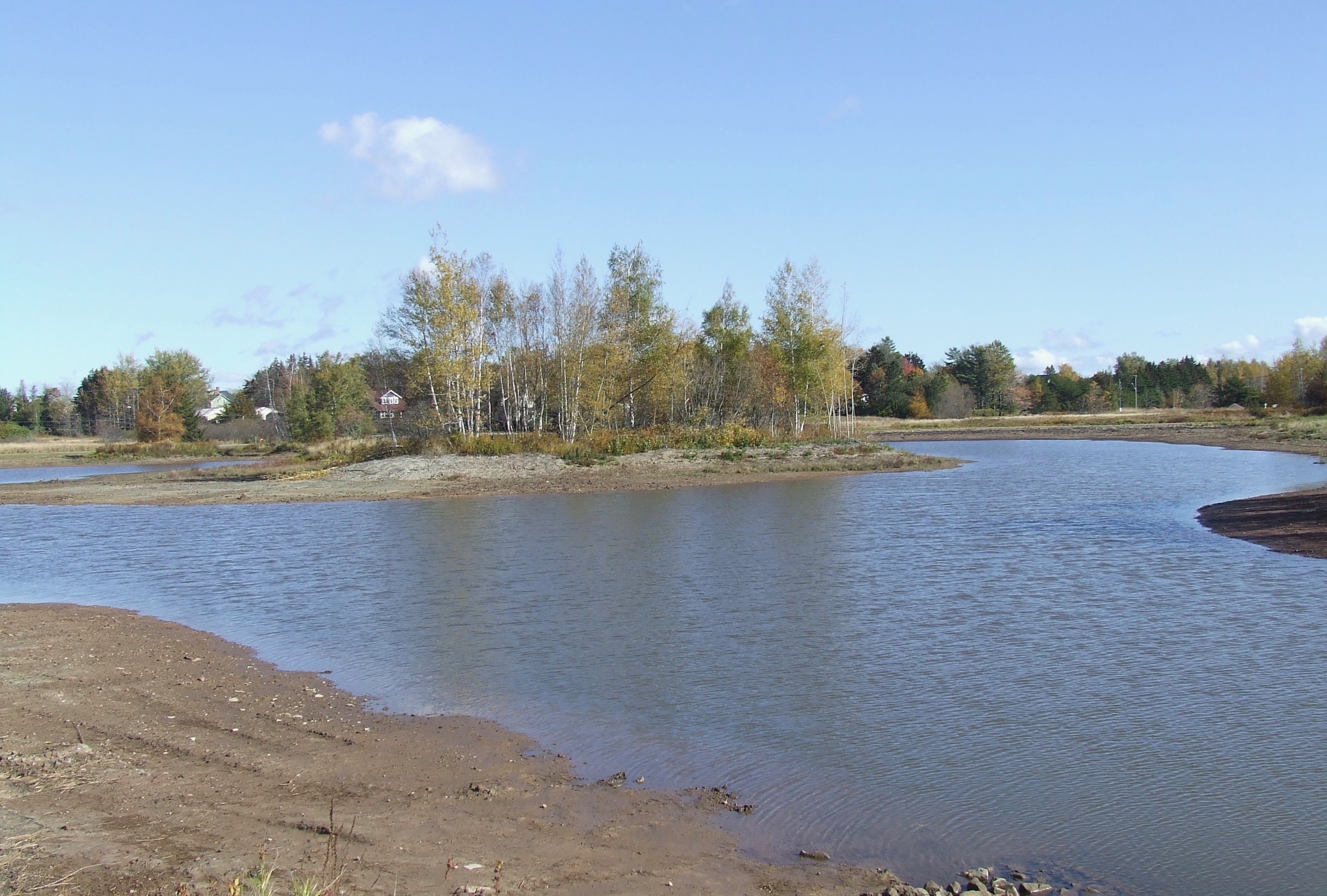
Sackville is seeking international recognition as the kind of small town that protects, creates and restores wetlands within its boundaries including its 75-acre Waterfowl Park.

“The Waterfowl Park is, for sure, the anchor in this and is a real jewel in a community anywhere in North America,” says Garry Donaldson, the manager of wildlife assessment and protected areas for the Canadian Wildlife Service (CWS).

Donaldson quickly adds, however, that Sackville’s application for formal accreditation as a United Nations Ramsar City Wetland Site will include other assets such as Silver Lake and the habitat created by the new 40,000 cubic metre pond that is part of the Lorne Street flood control project.

He explains that Ramsar is a convention under the United Nations that formally recognizes the conservation of wetlands of national and international significance.

The convention or treaty was first signed in the city of Ramsar, Iran in 1971. It took effect in Canada 10 years later, on May 15, 1981.

New Lorne St. flood control pond will be part of the application to get Sackville recognized as a Ramsar City Wetland Site

“It’s really a tool that Sackville can use to indicate to the world that it values wetlands and is going to be managing the area for the ongoing protection of those wetlands,” Donaldson said during a telephone interview from the CWS regional office on Waterfowl Lane.

“Considering that Sackville could become the first accredited city in North America, it gives a real power to the accreditation,” he added. “It puts Sackville sort of above the bar in terms of municipalities that are managing natural habitat.”

At its meeting last week, Sackville Town Council authorized Mayor Higham to sign the application form seeking Ramsar accreditation before the submission deadline of January 31.

Donaldson says accreditation would not create additional legal obligations for the town.

“From the town’s perspective, I see that as a bit of a win-win,” he adds.

“They gain the recognition for what work they’re already doing, but don’t have to sign onto anything that commits them to any liabilities down the road.”

Posted in Environment, Town of Sackville | Tagged , , , | 2 Comments

Sackville resident appeals to town council for help in preventing tragedy on Pond Shore Rd.

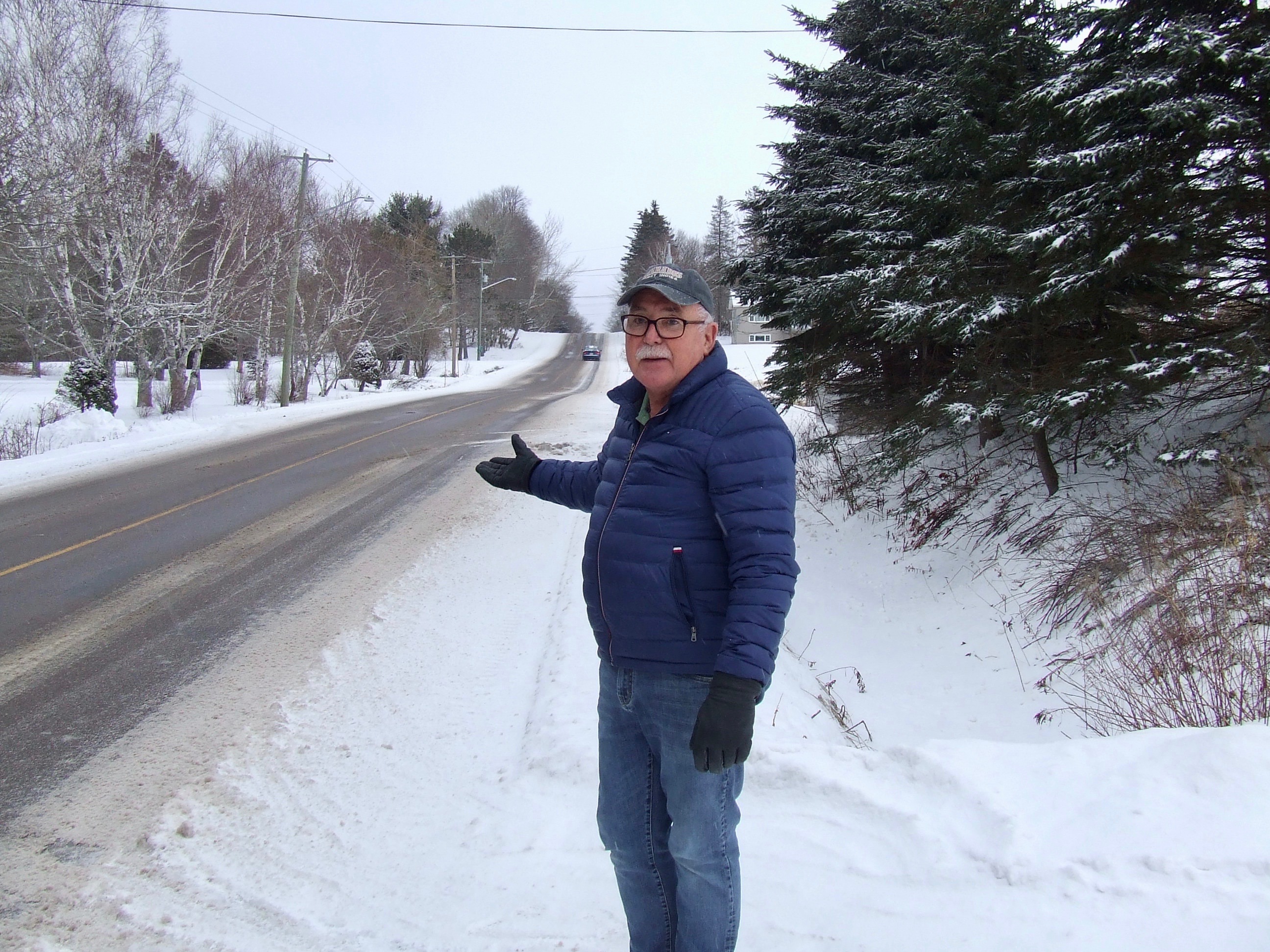
Don Gouthro gestures toward a blind hill on Pond Shore Rd., the site of a high-speed, hit-and-run collision on Dec. 23rd that sent a neighbour to hospital with serious injuries

A retired teacher warned Sackville Town Council last night that people’s lives are in danger because of excessive speeding on Pond Shore Road near Silver Lake.

“We fear that it’s going to be a tragic accident that occurs if something is not done,” Don Gouthro said.

He appealed to council for help in persuading the province, which is responsible for the road that is part of Rte. 940, to reduce the speed limit from 60 kmh to 50 and to install signs warning of hidden driveways and school bus zones.

He also asked council to push the RCMP for more frequent patrols as well as radar speed traps on the stretch of road between Uphill Drive and Mount View Road.

“There’s a lot of young children who stand here in the morning and afternoon to get on and off the school bus,” Gouthro said during an interview outside his home at 81 Pond Shore Road.

He pointed out that the neighbourhood is home to 18 children ranging in age from about three to 13.

“Our biggest concern is the safety of those kids right now,” he said.

“It’s scary. It’s a scary area.”

High-speed, hit and run

Charles Bourque’s wrecked car in a photo posted on Facebook

Gouthro pointed to a high-speed collision on December 23rd that sent a 69-year-old neighbour to hospital suffering from severe shoulder and back injuries, cracked ribs and whiplash.

The victim, Charles Bourque, says he was turning into his driveway at the crest of the blind hill when he was hit from behind by a pick-up that sent his car careening off the road as the truck driver sped away.

“I just passed out,” Bourque adds. He woke up with his car wedged between trees and a power pole.

“When a fireman come to the car and tapped on the window, he said, ‘Do you know who you are?’ I said ‘yeah I know that.’ ‘Do you know how you got here?’ I said, ‘no,'” Bourque told Warktimes.

“Next thing I remember is them putting me in an ambulance.”

Narrow road, heavy traffic

Meantime, Don Gouthro is circulating a petition among his neighbours calling for change.

In the draft of a letter he may send to town council, Gouthro writes that fully loaded, tandem logging trucks travel Pond Shore Road during times of the year when there are no weight restrictions while at least one construction company uses it to get access to a gravel pit.

Don Gouthro addresses town council

His letter points out that a guardrail runs alongside the road for 800 metres beside Silver Lake in an area frequently used by university students who jog and bike there.

“The width of the shoulder of the road from the guardrail to the pavement’s edge is barely able to accommodate the width of an average baby stroller,” the letter says, adding that foot traffic is often forced to use the paved roadway because the shoulder is at times overgrown with weeds or clogged with snow while sections of the opposite shoulder are either washed away, strewn with rocks or overgrown with weeds.

Gouthro told town council last night that when he complained about road safety 10 years ago, the province removed the blind hill warning sign apparently because it wasn’t politically correct, but did nothing else.

Council response

Acting Mayor Ron Aiken said that when town council called on the province to change the speed limit about 10 years ago, provincial officials said no.

“It’s a provincial road and it’s their jurisdiction,” he said.

At his suggestion, council passed the following two resolutions:

Moved by Councillor Michael Tower and seconded by Councillor Andrew Black that council prepare a letter to the New Brunswick Department of Transportation and Infrastructure (DTI) and the Member of the Legislature (MLA) requesting that the speed limit on Route 940 Pond Shore Road be reduced from 60KM to 50KM to the town limit and that DTI install proper signage in the area.

Moved by Councillor Michael Tower and seconded by Councillor Bruce Phinney that council make a request to the RCMP to increase patrols on Route 940.

RCMP response

Meantime, Sgt. Paul Gagné says the RCMP is aware of speeding in various parts of Sackville including Rte. 940.

“We do make patrols there quite a lot already,” he said during a telephone interview, adding that the police are especially vigilant during times when children and other vulnerable people are present.

Gagné adds that it’s always good when people report speeding issues so that police can follow up.

“We go to areas where we’re asked to,” he says.

He also encourages people to report habitual speeders and identify their vehicles so that the RCMP can visit them.

“People don’t necessarily recognize that they’re going over the limit,” he says.

Charles Bourque says Rte. 940 is “just like a raceway”

He also says the RCMP have launched a criminal investigation into the hit-and-run collision on December 23rd, but so far, no one has been charged in connection with the crash.

For his part, Charles Bourque says that over the years, he’s signed several petitions calling on the province to change speed limits and install warning signs, but nothing ever happens and he’s afraid nothing will.

“It’s just like a raceway all the way from the bridge at the lake to Midgic,” he says.

“They have to do something or somebody’s going to get killed.”

Posted in New Brunswick government, Town of Sackville | Tagged , , , | 3 Comments

Green MLA calls for proportional representation, not a smaller legislature

Green MLA Megan Mitton

Local Green MLA Megan Mitton is calling on Premier Higgs to implement far-reaching electoral reform instead of musing about cutting the number of seats in the New Brunswick legislature.

“Frankly, I’m disappointed to hear that type of discussion happen as if democracy is the problem here,” Mitton said during a year-end interview in Sackville last week.

The member for Memramcook-Tantramar was commenting on a recent report in the Irving-owned Telegraph-Journal in which Higgs is quoted as suggesting that since MLAs can be “barriers” to economic prosperity, it might be a good idea to reduce their numbers in the legislature.

The newspaper adds that although Higgs isn’t seriously considering chopping the number of MLAs from the current 49, the issue concerns him because it’s a “struggle” to persuade politicians to support economic development initiatives if they don’t garner votes in local constituencies.

Mitton suggested that having less representation in the legislature would do nothing to solve the province’s real economic problems.

“Some of the major problems we have in New Brunswick have to do with the monopoly we have around the press, around industries, and it’s not about the people working in those industries, it’s about how the power and wealth is distributed in our province,” Mitton said.

“Frankly, if we’re going to look at electoral reform, I’d like to see proportional representation,” she added.

Mitton pointed out that a Progressive Conservative government led by Bernard Lord established a commission to study legislative democracy in 2004 and when it recommended a system of proportional representation, the premier promised to hold a referendum on it during the municipal elections of 2008.

However, when Lord lost power in the 2006 provincial election, the Liberals scrapped the idea. (To read Professor Paul Howe’s study of proportional representation in New Brunswick, click here.)

“The idea for proportional representation has been around for a long time,” Mitton said, “so I’d like to see Higgs do that.”

Posted in New Brunswick politics | Tagged , | 9 Comments

MLA Megan Mitton calls on province to summon political will for big changes

MLA Megan Mitton and Sackville Mayor John Higham at 2020 New Year’s levee

Megan Mitton says one of the things she learned during her first year in the New Brunswick legislature is that there isn’t much political will to make changes.

“There’s really a lot that needs to be done,” the MLA for Memramcook-Tantramar said during an interview at the mayor’s New Year’s Day levee last week at Sackville Town Hall.

“There’s all kinds of things that need to happen,” she emphasized, “everything from making sure that the extremely rich are paying their fair share, to making sure that we are properly funding nursing seats in our province to help address the nursing shortage, to passing a ban on conversion therapy.”

Mitton explained that conversion therapy is the “disproven and harmful practice of trying to change someone’s sexual orientation or gender identity usually through psychological means.”

She says she raised the issue in the legislature a couple of times, but after meeting with people in the LGBTQ community, is now drafting her own bill and plans to work with members of the other political parties to get it passed.

“This is something that wouldn’t even cost the government money, but is about protecting human rights,” she said, adding that other provinces, including Nova Scotia, have already banned conversion therapy.

Clinic 554

Mitton questions Premier Higgs in December about provincial funding for Clinic 554

Mitton has also been pushing the provincial government — so far, without success — to pay for abortions and other medical services, such as care for HIV patients, at Clinic 554, a privately run facility in Fredericton that has announced it may have to close if it can’t get provincial funding.

Successive New Brunswick governments have maintained the policy of funding abortions at three public hospitals, one in Bathurst and two in Moncton.

“The best practice is to provide this service in a community-care setting,” Mitton says.

She argues the province’s refusal to fund abortions outside of hospitals violates the Canada Health Act and forces many women to travel long distances.

“Transportation to get to medical services is a challenge anyway for a lot of people,” she says. “There’s also the timeliness factor for being able to access surgical abortions.”

Green bills

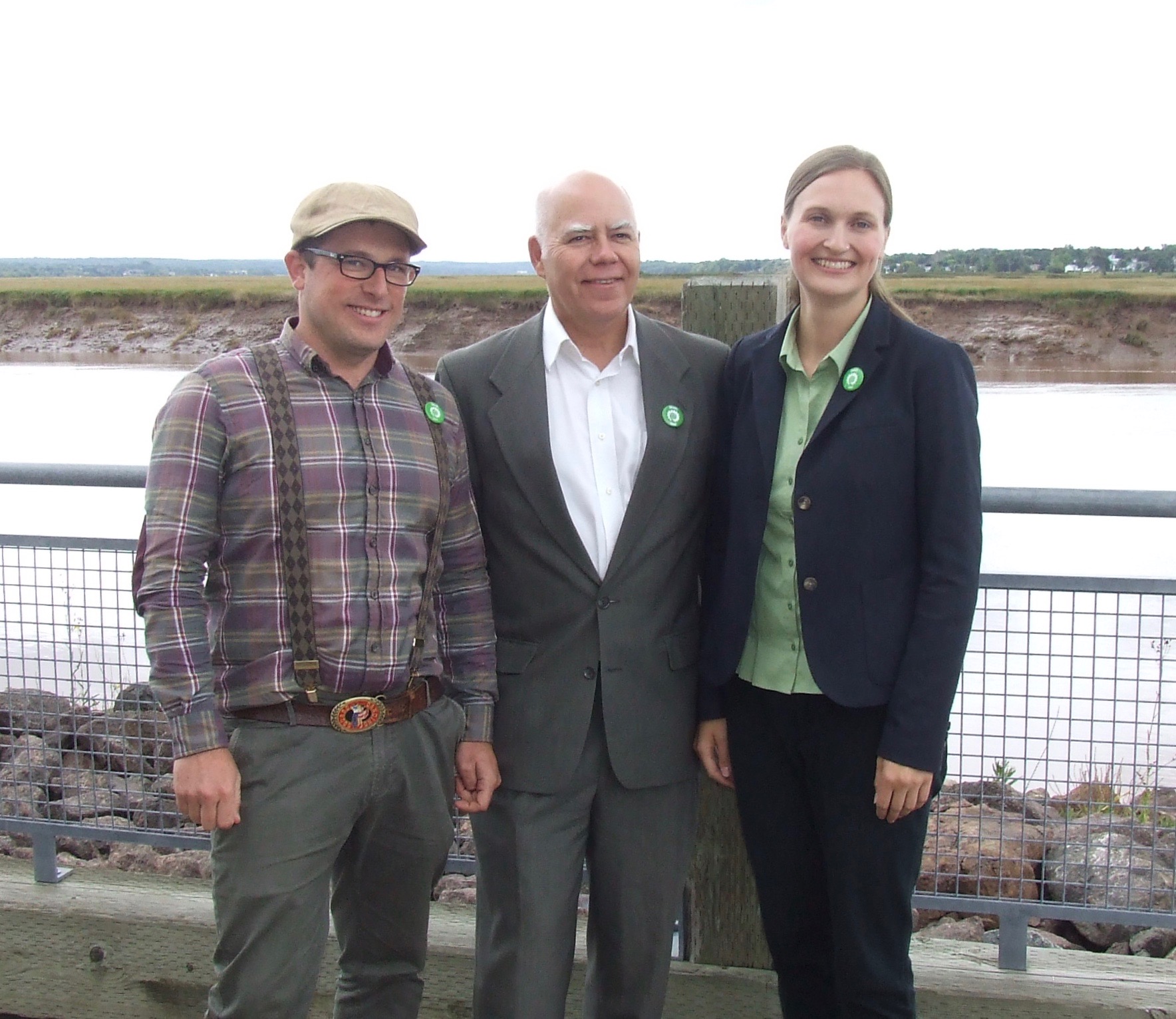
The NB Green caucus. Party leader David Coon (centre) with Kevin Arseneau and Megan Mitton

Mitton referred specifically to a couple of bills the three-member Green caucus introduced during the fall sitting of the legislature.

One, to amend the Crown Lands and Forests Act, would ban spraying the herbicide glyphosate on Crown forests while also requiring mills to buy more wood from private woodlot owners.

Another, to amend the Family Income Security Act, would allow the provincial minister of social development to work with the federal government to ensure a basic income guarantee for all New Brunswickers.

“Poverty is really such a huge issue in New Brunswick especially for seniors, especially for children,” Mitton says, “and if we aren’t willing to figure out ways to take care of everyone, to make sure they have what they need, then we’re really failing as a society and as a government.”

Mitton explains that the Green bill would replace social assistance rates with income guarantees and require the government to review them regularly.

She points out that current social assistance rates haven’t increased since 2014.

“It’s not enough to live on,” she says. “It’s $537 a month for a single person and it’s very hard to imagine how to find housing and food and heat with that amount and there are strict rules around not being able to even share your residence,” she adds.

“It’s not designed to really lift people out of poverty.”

Sackville & climate change

Earlier, Mitton told about 60 people at the mayor’s New Year’s Day levee she’s proud to represent Sackville and its surrounding communities in the provincial legislature.

“Sackville is always a leader,” she said.

“One thing I want to really highlight is the mayor and council’s leadership bringing together a round table on climate change,” Mitton added.

“That’s one of the defining issues and challenges that we face and I’m very proud that our town is innovating and finding ways to address that.”

Posted in New Brunswick politics | Tagged , , , | 5 Comments