

Demonstration organized by Action Cap-Acadie outside EUB hearings in Moncton. Photo: Juliette Bulmer
About 20 demonstrators chanting, “Hey, Hey, Ho, Ho, the gas plant has got to go,” marched outside the Moncton hotel today where the Energy & Utilities Board was about to open five days of hearings on NB Power’s plans for a 500 MW generating plant on the Chignecto Isthmus.
The demonstration was organized by Action Cap-Acadie which had invited everyone to “stand with us to protect our land, our health, and a clean-energy future.”
After the hearings began, various interveners spent the day quizzing five NB Power executives about their proposal to pay an American company to build, operate and eventually decommission the gas/diesel plant in Tantramar.

NB Power panel was cross-examined by interveners during the 1st day of hearings. L-R: Kevin Wright, Jordan Russell, Brad Coady, Darren Clark, Jonathan Pollock
St. Thomas University Economics Professor Andrew Secord asked the NB Power executives for a “ballpark figure” on what the gas plant would cost the utility over its projected 25-year lifespan.
NB Power Vice President Brad Coady seemed reluctant to answer.
“We’re not the builder of the project, we’re not the owner of the project, so we don’t know the full capital cost,” he said, suggesting nevertheless that NB Power did have “a good line of sight” on what it might cost every year.
“We do think it’s a significant amount of money, if I could say it that way,” he added.

EUB Chair Christopher Stewart
“I’m not sure you answered Dr. Secord’s question,” EUB Chair Christopher Stewart said. “I think he was asking if you could give him some kind of ballpark number.”
“We can’t say on the record what it would cost us per year,” Coady answered, finally adding that over its lifespan, the capital cost of the plant would amount to more than a billion dollars.
He said NB Power would also have to cover the U.S. company’s operating and financing costs including return on equity and return on debt, plus any insurances.”
Although Coady didn’t mention it at today’s hearing, NB Power would also be required to cover the costs of burning diesel fuel and imported natural gas.
Dramatic exchange
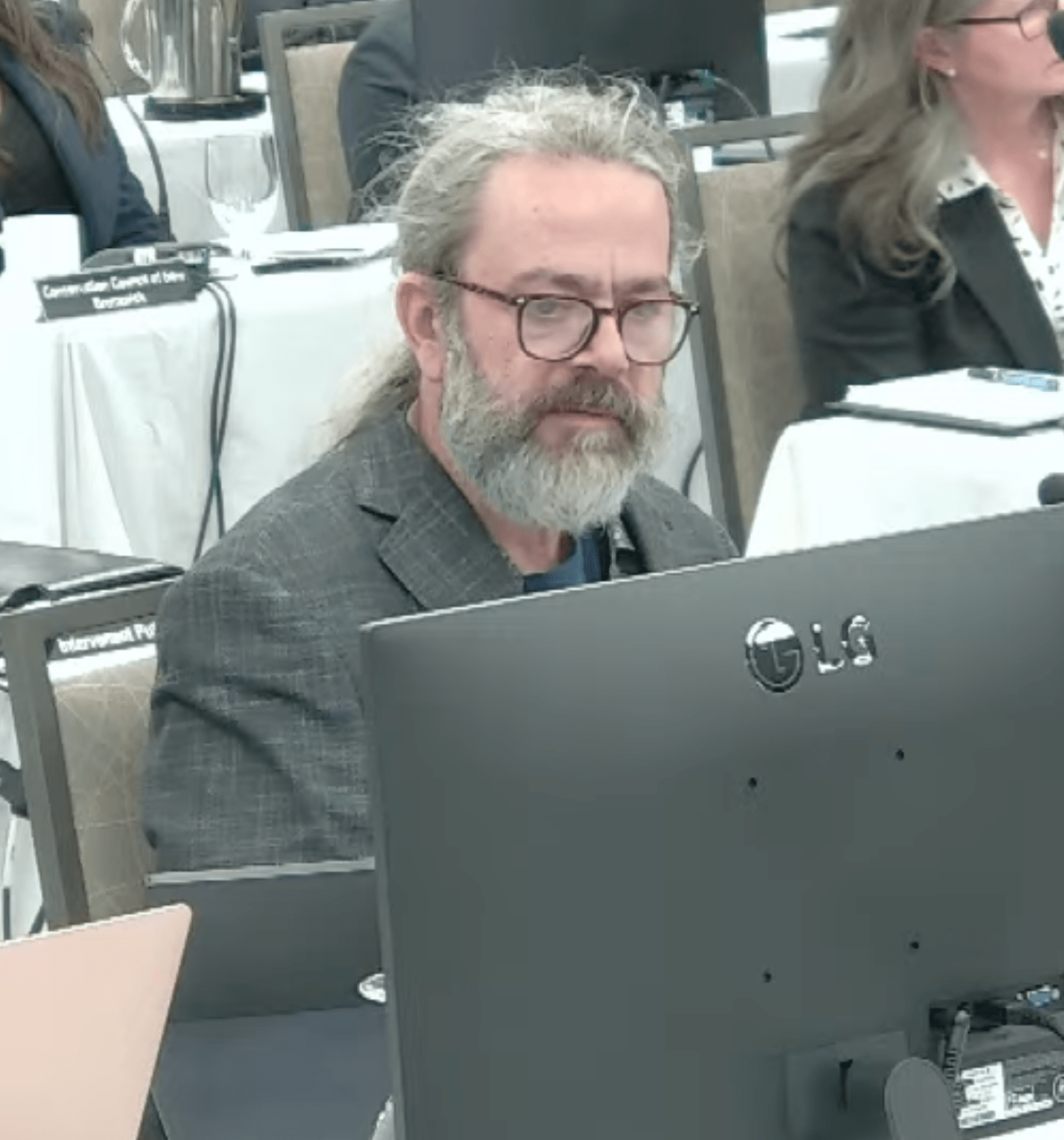
PCIC Intervener Chris Rouse
Chris Rouse, intervener for the Protect the Chignecto Isthmus Coalition questioned the NB Power panel about their contention that 400 MW from the gas plant would be used to generate electricity that is needed in New Brunswick, with an additional 100 MW for sale to Nova Scotia.
New Brunswick’s 400 MW would be generated by eight gas turbines (8 units) with two additional ones (2 units) generating power for Nova Scotia. (Each unit would generate 50 MW: 8 x 50= 400 MW; 2 x 50 = 100 MW).
Brad Coady repeated today what he has said at various public meetings: The province could run short of power unless it gets that 400 MW from the proposed gas plant.
But Rouse pointed to a chart from an NB Power document that appears to show half of the 400 MW could be exported undermining NB Power’s claim that without that power, New Brunswickers could face rolling blackouts starting in 2028.

NB Power chart with the financial details blacked out
Coady responded that the table was created to show various ways of thinking about how NB Power could lower the cost of satisfying the province’s need for 400 MW.
“Just to make sure there is no confusion in the room, there is now only one expansion toll agreement, one contract for offtake with our neighbours,” he said referring to the tentative export deal with Nova Scotia for 100 MW.
“But the table says four units for in-province,” Rouse responded. “You just told us at the very beginning that this 400 MW was for in-province. This table is only showing 200 MW for in-province.”
“Again, just to make sure there’s no confusion, this was just two options,” Coady answered.
“NB Power’s thinking never deviated from about 400 megawatts, or in this case, eight-unit option for a total of 376 megawatts net to the system. That’s been our base-case-thinking all along,” he said.
The EUB hearings continue Tuesday at the Delta Beauséjour in Moncton starting at 9 a.m.
For Erica Butler’s, CBC coverage, click here.


Why would NS power buy power from NB when it is beginning an off shore wind farm with an over abundance of power being produced. NS is currently planning on a joint investment with the New England States. NS power has determined it would only require 1/4 of the power produced. If we are in desperate need why wouldn’t we import it from NS ? Doesn’t this make more common sense?
My ancestors were some of the first settlers on the isthmus in the mid to late 1700’s and i would hate to see this area have an environmental disaster.