

AI generated image of 400 sq. ft. rectangular home suitable for transport on N.B. highways
Tantramar Town Council has voted to consider changing its zoning bylaws to allow for small, rectangular 400-square-foot houses in residential areas.
Council will consider the zoning change at its next regular meeting on November 12th.
It was responding to an application from local resident Natalie Donaher who says she’s been working with non-profit groups on smaller, cottage-style houses that can be built somewhere else, then moved to Tantramar by road.
“This particular [zoning] amendment was to create opportunities and possibilities for those folks that are interested in small-footprint housing that can’t find local carpenters, since they are so busy, to create 20 by 20 foot squares, but would rather have a small-footprint rectangle built offsite and brought into our municipality,” Donaher told reporters.
She explained that the 20 by 20 foot square buildings — currently allowed under the zoning bylaw — are too wide to be moved by road, but a narrower, rectangular home with the same square footage would be OK on the highways.
Housing crisis
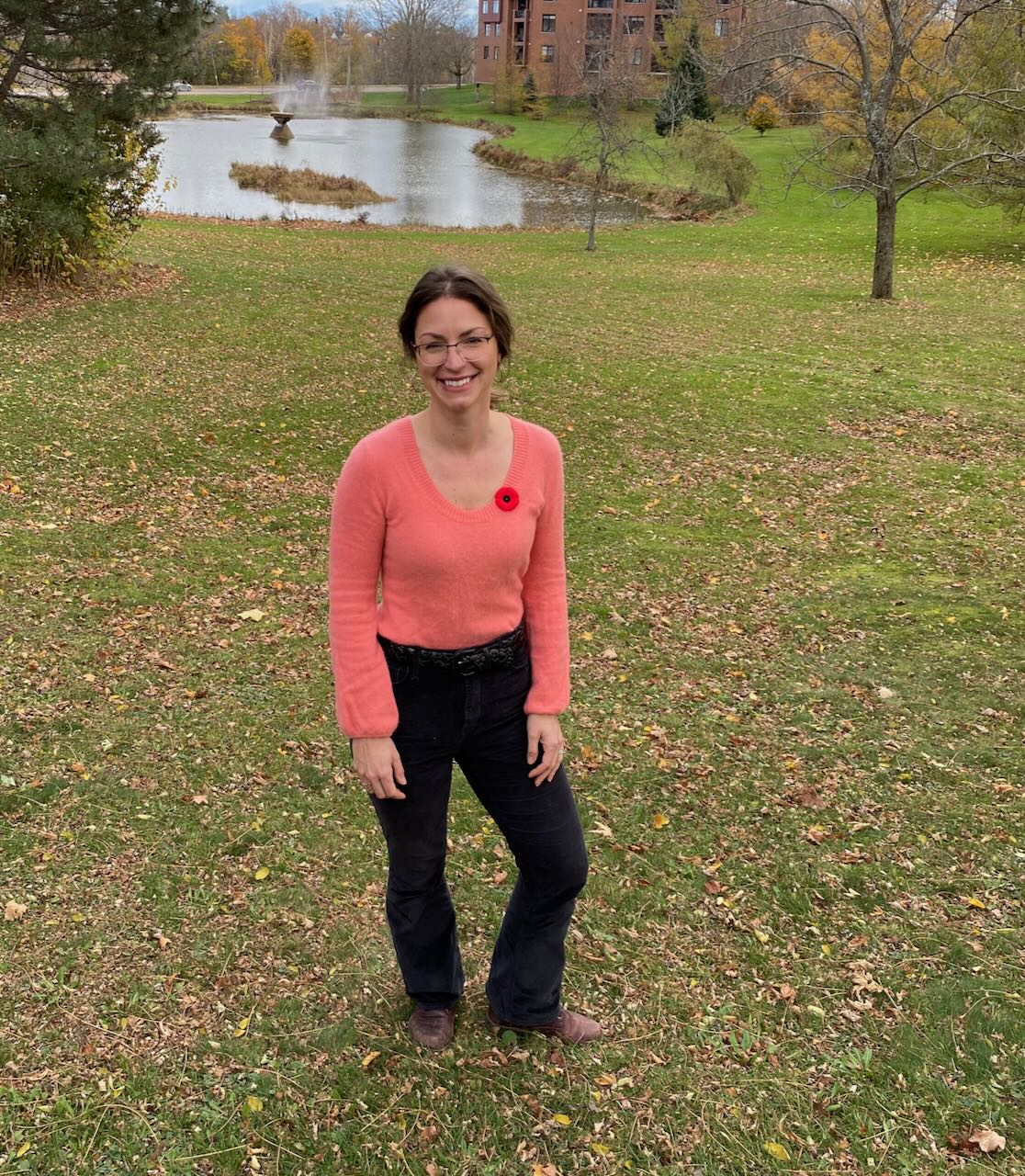
Natalie Donaher, pictured in 2022 as she was running for council in Ward 2
Donaher says she applied to change the bylaw to help resolve the housing shortage.
“The housing crisis is only ever increasing,” she said, “and I’ve been speaking to and listening to stories in the last two to three months of individuals who are having a difficult time finding housing here and would like to move to our community.”
She added that these cottage-style homes are not classified as tiny homes like the 200-square-foot dwellings in Fredericton’s 12 Neighbours project.
Town planner Jenna Stewart told council that the current width requirement of 20 feet was probably adopted for aesthetic reasons so that smaller homes don’t look like mobile trailers which typically have a maximum width of 18 feet.
Donaher says she realizes the town may consider allowing even smaller homes when it reviews its municipal plan, but for now, she feels 400-square-foot rectangular ones would meet the needs of people on tight budgets.


Please resist the temptation to post AI-generated images. They’re based on theft and normalizing their use deprives people of their ability to make a living.
Oh please… theft from whom?
AI searches for and blends the artwork of various artists together to make the picture that is requested. It is actually stealing from legitimate artists to make these images.
Artists are not being paid for the artwork used, they are having their copywright broken and they’re not being credited with the image.
AI would be fine for personal uses, but in anything ‘published’ and seen publicly, that’s a whole other issue. As an artist myself, I have to agree with Christopher; look for other ways to find images, don’t use AI.
@Marika Theft from people like me. People whose artwork was ingested wholesale by AI companies without permission or notice to train their AI models. This stuff doesn’t come out of thin air.
In addition to exploiting artists (and taking work away from them) AI is also wasteful of energy. AI data centres, like those for cryptocurrencies, use vast amounts of power, often generated from fossil fuels.
I’m all in favour, but from the point of view that I see no reason why such things should be regulated in the first place!
Copyright is regulated by governments. Major corporations will take you to court for copyright infringement. Smaller players have little recourse when their content is taken without permission. It happens a lot.
https://jarche.com/2023/04/getting-scraped/
Thank you so much Natalie! I hope the town will promptly change the bylaw so that people can buy smaller houses that are so much more affordable. This would put us in line with neighbouring communities like Memramcook. There are already a number of small houses in town that existed before the bylaw. These houses are more cost efficient. Thanks for your great work, Natalie!
Feeling a little guilty for having hijacked the topic here, so I’d like to chime in with my full support for the changes Natalie Donaher is advocating for. Tiny homes are perfectly valid mode of sustainable living, and the long-term opposition in many districts is largely based on ignorance and bureaucratic over-reach. Here’s hoping Tantramar council sees fit to move forward.
A Donaher Cottage or not-so-tiny-but-still-pretty-tiny home would be 12X33 or so then? Put on a transport truck coming to the empty lots available in town is that a plus? Really small accommodations for a single or couple’s living arrangement but better than living in a tent. Built by local builders says Natalie and transported to the site like a pre-fab home to be set upon a foundation basement level? This sort made by supremehomes.ca [see their small homes selection at their website]. If someone can afford to buy a lot and get the services in, permitting, they most likely can go a little larger than 400 sq ft in area so I’m not so sure you’ll see a lot of these “cottages” but its their choice or at least it should be their choice. Josh Goguen was trying to suggest in the Town Council meeting that allowing the current homeowners of properties to perhaps put ADU or granny cottages on their existing property to ease the housing shortage would probably go a long way to help create more accommodation and that’s also true. Why is there really a housing shortage in this university town packed with international students? That’s the honest question no one wants to answer — why people are so afraid to discuss the glaringly obvious impacts of mass immigration. Some say all the immigration creates opportunities for our society — housing crisis should trigger housing builds but it seems to trigger scarcity and poverty instead… were we lied to? In the past 14 years I have seen Lafford build many many new buildings but its still a town with a shortage of housing.
“Why is there really a housing shortage in this university town packed with international students? ”
Because they’re students, some of whom are housed on Mt. A Campus. Those that go off campus may share housing – whether a student house of multiple bedrooms or an apartment – which can ‘double up’ people in one place (or more).
There’s a housing shortage in town because actual houses cost an insane amount of money now, there’s no relief in sight for that. Also, rents are going up (though that could be squashed with decent rent caps). Thirdly, we’re getting not just international people, but others from Canada moving to Sackville – a lot of homes that are bought, or have been, by people from out of town and even province (Ontario mainly). Fourth, seniors are downsizing and with more moving into apartments, more houses that are too expensive are going up, to get gotten by people from out of province/town. Lastly, there is no low income rent/housing for those who need it in town, yet a lot of the jobs in town are low income/minimum wage, which means out of reach by anyone wanting to buy a house (meanwhile they pay more than the mortgage on a house in rent…).
Mass immigration did not cause the housing shortage, that’s a fear mongering talking point from anti-immigration people.
You are right, the immigration should have created builds, and they have, but they’re not going up fast enough, and when they do, they’re taken by people who have the money first. Immigrants coming to work here do NOT usually have access to the higher end prices for apartments that are going up in town, since they usually only work the minimum wage jobs.
Bruce, you really need to stop with the AI generated images. It’s unprofessional. This, coupled with your “premier-elect” gaffe really has me questioning your credentials as a journalist. Not good, man!
With just 61% voter turn-out would you be more comfortable with Premier-Selected Bruno? AI images got people worked up on here.. weird really.. those ones of the puffer jacket wearing Pope were just epic.. they went viral on Twitter.
Artists have a right to be “worked up” over AI images, since their work is being stolen to fuel them.
Or does that not bother you at all?
Experts, such as Michael Geist who is a law professor at the University of Ottawa, point out that copyright issues relating to AI training using large language models (LLMs) are far from clear. In his submission to the federal government’s copyright consultation in January, Geist pointed out that these issues are “currently before the courts around the world in multiple cases that raise questions related to inclusion of copyrighted works within LLMs, whether such use constitutes infringement, and the potential application of limitations and exceptions.”
Geist recommends that Canada include a text and data mining exception in its Copyright Act’s fair dealing provisions as many other countries have done.
“The federal government has invested millions to support research and commercialization of AI in the hopes of making it a world leader,” he writes.
“Canadian copyright law inhibits this because restrictive rules limit the data sets that can be used for machine learning purposes, resulting in fewer pictures to scan, videos to watch, or text to analyze. Without a clear rule to permit machine learning, the Canadian legal framework trails behind other countries that have reduced risks associated with using data sets in AI activities in a manner that fairly treats both innovators and creators.”
Here is a link to Geist’s submission: https://www.michaelgeist.ca/wp-content/uploads/2024/01/Geistgenerativeaicopyrightsubmission.pdf
The copyright might be “far from clear”, Bruce, but out of respect for people who are artists, until the decision of whether it is open to copyright or not, why not just use real photo’s instead of AI generated ones?
Considering the use of it has detracted from the article itself, that might be at least proof enough of the use of AI is a questionable decision right now.
Thanks so much for your comments Elaine.
I looked for photos/illustrations on Pixabay that are copyright free, but they do not illustrate the small, rectangular design that is needed for highway travel in New Brunswick. (As I mention in my report, the square 400 sq. ft. design is permitted under the local zoning bylaw, but Natalie Donaher says there is a shortage of carpenters here to build them on site.) If I were to use photos from a website advertising cottage-style homes (and I found there are many), the images would not be copyright free. And there are no such small homes anywhere near here that I could photograph myself.
As for respecting artists, here’s what Michael Geist writes about AI training: “The process of training an AI necessarily involves breaking large quantities of data
apart, clustering, putting things that are similar together and then passing them through a noise filter.18 At the end of this process, there is little left of the original work in the AI model, with some exceptions.19” His footnotes (18 & 19) refer to the article: “Diffusion Art or Digital Forgery? Investigating Data Replication in Diffusion Models” https://arxiv.org/abs/2212.03860
Whether we like it or not, AI is here to stay and governments (which are massively supporting it as a 21st-century economic engine) will need to work out new sets of copyright (and privacy) rules governing data and images available on the Internet. Anybody who has read, as I have, Shoshana Zuboff’s 691-page tome “The Age of Surveillance Capitalism: The Fight for a Human Future at the New Frontier of Power” knows all too well how the routine “scraping” of personal data from Internet sites such as Facebook, Instagram & X fattens the profits of big corporations and the billionaires who run them. And even more worrying: this personal information is shared with national security agencies that command state tools of enforcement and repression.
And yes, then there is Mustafa Suleyman’s book: “The Coming Wave: Technology, Power, and the 21st Century’s Greatest Dilemma” warning that without strong state intervention, unbridled AI threatens human survival. Suleyman tries hard to strike a note of hope, but he also points out that previous obliterating technologies such as nuclear weapons remain uncontrolled, ready to wipe us out at a moment’s notice.
I would also agree with Christopher Mackay’s comment that AI threatens livelihoods — but not just of artists, graphic designers and journalists, but of nearly everyone who works today. We might choose to re-distribute the wealth AI generates through guaranteed annual incomes or, we could simply abandon displaced people to further economic immiseration and psychological despair.
Wikipedia (itself an Internet phenomenon) reports: “The Prince Edward Island government voted to ban automobiles from the Island in 1908, when there were only seven cars on the Island, due to residents’ concerns over their safety, that they frightened horses and livestock, and due to the quality of Island roads.”
While the PEI legislators may have been right in the short term, they did not foresee the perceived benefits of motorized transport to a public which now spends more on personal vehicles than on public and private health care. Governments responded to the internal combustion engine with a variety of regulations, but so slowly that many thousands died because of faulty vehicle and roadway designs and lax impaired driving laws.
Again, AI is here to stay with all of its perceived benefits and losses. So too is the Internet without which my news blog would not be possible. The Internet overthrew the mainstream media dependent on ad dollars, yet Warktimes somehow exists because of it. Double-edged swords.
Geist’s take is legal; mine is ethical.
No one asked me before setting their crawlers to ingest my artwork, I wasn’t given the chance to say “no”, no one negotiated a price (which I get to set and which others get to balk at or accept). It wasn’t on some social media’s company’s servers, safely covered by their terms of service. It was just taken — as was the work of any other artist posting their work online. And now generative AI tools spit out images like the one on this story.
The fact that this harm is diluted across so many artists changes nothing about the sleazy nature of all this. The amount of money (and energy) being wasted on this slop just proves how lucrative it can be, but the source of the initial imagery is cut out of financial remuneration entirely.
Maybe this will be more relatable once AI-generated text supplants the work of — and need for — journalism? But then that’s already happening, isn’t it?
In reply to Bruce’s comment earlier, Michael Geist had proven himself over the years to be an enemy of those who create works and who rely on copyright to protect their intellectual property from exploitation.
Geist advocates the inevitability of copyright erosion, and has an almost religious zeal for exploiting and using others’ work without compensation. The fact that “The federal government has invested millions to support research and commercialization of AI in the hopes of making it a world leader” tends to lead to the conclusion that the government has dragged its heals on protecting copyright holders, from AI and from the past decade of theft by schools and universities, because government is in a conflict of interest, and is incapable of defending intellectual property through copyright, which is the foundation of innovation.
In effect, government is subsidizing the undermining of copyright. Instead of government funding being directed (in part) to compensate those used for AI training, that funding is rewarding those who are exploiting copyright holders for profit.
I’ve generally found Geist to be tiresome, and have long-since stopped paying attention to him. He’s like Cory Doctorow to me; inoffensive and uninteresting.
“Sign the Mona Lisa with a spray can, call it art.” Robert Hunter
I get the concerns. But to me it is like activists exploiting an artwork by throwing paint on it to draw attention to a cause, or defacing monuments. Both are an affront to the artist who created them. So if you have trouble with AI generated art, you should also have a problem with the latter. To me, these issues are pretty grey and present legal and ethical issues that are far from clear cut.
Would love to hear more about how you “get the concerns”; I see no indication you do.
AI trained on material without permission or compensation — while sharing none of the revenue — is in no way like activists “exploiting” an artwork.
The false equivalence of political statements (that just so happen to involve art) with the theft and resale of intellectual property on an unprecedented scale is absurd on its face.
I was not aware that copyright prohibited learning from others’ original artistic expressions, whether this is learning by humans or machines. If you put a song, poem, painting, academic article, etc. online, I don’t think you can reasonably authorize the particularities of its use for learning purposes by others (reproduction is another matter, hence Fair Use guidelines in Universities). As Bruce Wark quotes Professor Geist (who some seem to have a real hate-on for), since AI pulls from so many diverse sources of online expression, the ability to discern a direct rip-off from any particular work is minimal. Now by all means, you rightfully feel slighted that you didn’t authorize big tech from incorporating your art for their machine learning. Just like monument artists may not like the exploitation of their works for some political purposes, but maybe wouldn’t mind their work being used by students in a drawing class. But once anyone puts anything on the internet it is pretty hard to control how that may be used. I get that big media players like the NYT are now challenging the use of their archives by AI firms, which is why I think this is very much a grey area that may change soon. But it is not like AI is reproducing the NY Times archives, they are learning from them. This isn’t Kanye sampling King Crimson, where the original work is obvious in the new work that incorporates it. If you can meet the Kanye/King Crimson threshold in demonstrating your paintings, or significant elements of them, being clearly discernable in say a generative AI image that Bruce or anyone else creates, then, you have a point. But in this case, I’d go with the expert on AI and copyright.
Yes, AI uses a lot of water and power. So maybe stop using your computer and cell phone, since I guarantee these tools indirectly play into these resource uses. Let’s hope these tech companies figure how to be part of the solution or are regulated to do so. I am in Japan at the moment. Abandoned fields all over the country are being turned into solar farms. Lots of trade-offs and choices to make.
Hey Bruce, judging by these comments you should set up a paywall and subscription service if people are expecting that kind of reporting. Let’s all remember Bruce does all of this without being paid a single dime and you guys sit here and whine and complain about the most minute and mundane details of his reporting. Yall must have pretty sleepy lives eh? Not much going on on the marshes these days I guess.
AI images? Straight to jail
Using wrong terminology? Again, straight to jail.
Get a life Sackville it’s a f*cking blog.
While it may seem to you that to bring up the request to not use AI images is “whining”, it’s not. It’s about recognizing that AI is problematic right now.
I completely understand why Bruce did it but it doesn’t negate the fact that in order to generate the image, there is artwork being stolen, people’s work and time not paid for and in that, it’s not right to do. I’m sure if someone used Bruce’s work to enhance something they did, he wouldn’t be too happy about it.
No one is saying “AI images, straight to jail”. It’s “If you use AI images, it comes across as not supportive of artists”.
It’s a public blog that reports local news, which is different than a private blog.
Appearances matter.
I will say if Bruce got the AI image from a site that has a paywall or some sort of payment required to access images, that would change things a little bit. Not a lot, but at least to me it means there was some sort of payment for it. While it might not go to the actual artists that contributed to the image… it’s still paid for.
Since you link your name to the Communist Party of Canada, it isn’t surprising that you have a hostility to the idea of property, and intellectual property.
If AI exploitation of intellectual property were being done by the general public directly, it would have similarities to communism. Since it’s being done by large corporations, it’s ironic that you are so hostile to artists — workers — protecting themselves from exploitation by big capitalism.
And for the sake of restoring some sanity to the conversation: nobody suggested Bruce should go “straight to jail”. You’re putting words in others’ mouths to ridicule them rather than address their concerns. It’s more in line with the history of communism to send people “straight to jail” for using the wrong terminology.
Wow, you take things very literally Jon. Lighten up